
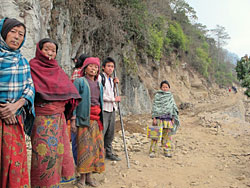
 PICS: KUNDA DIXIT CASH FOR WORK: Local women in Bhojpur on a section of the new road to Dingla being built under the Rural Access Programme. |
Much of this destructive, mechanised road-building doesn't create jobs, it opens up the hinterland to exploitation, and most roads are washed away in the first monsoon.
Yet there are working examples of road construction in Nepal that generate rural employment during construction and after, benefit local farmers, and are sensitive to the environment. Several of Nepal's donors are now supporting projects that seek to reduce poverty through this road-building model.
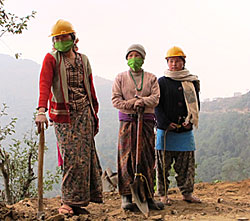 Because of the out-migration of menfolk, it is the women who work in the road builder's groups in Bhojpur. |
The philosophy is to go beyond just the highway to generate income through labour-intensive road-building, improving livelihoods by providing access to rural produce, and organising local road-builders into savings cooperatives. RAP has done with roads what user groups did to conserve Nepal's community forests.
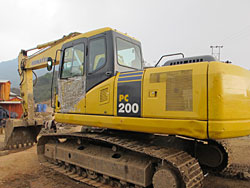 Bulldozers and excavators have their uses, but overuse has displaced people and destroyed farms. |
RAP employs villagers within a 90-minute walk for sections of the road, and an average road builder can earn up to Rs 100,000 a year. This has reduced the number of people migrating to India or the Gulf for work (see box).
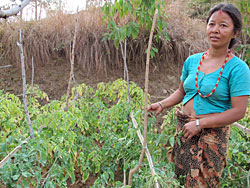 Many, like Laxmi Shrestha, invested the money they earned in vegetable farming so they can send children to school. |
RAP was started in 2000 with the Hile-Bhojpur road, but work stalled during the war. Restarting in 2006, it has provided employment to 25,000 farmers building roads in Bhojpur, Khotang, Sankhuwasabha and Terathum, and helped organise farmers into cooperatives. The road-building model has been extended to Dailekh, Accham and Doti in western Nepal.
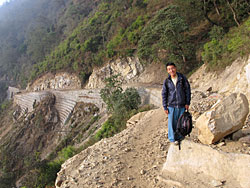 Bibas Rai is determined not to leave his village, he says he will help others increase earnings by farming vegetables. |
In Bhojpur alone, wages for road workers injected Rs 1 billion of cash into the economy over the years, and the effect can be seen in the bustling Saturday market where farmers like Laxmi Shrestha come to sell their produce. Orange farmers can now sell a kilogram of oranges for five times more in Dhankuta.
None of this would have happened if the road had been built by excavators. "The bulldozer only benefits its dozer-owner and harms the slopes," explains Bhojpur's Local Development Officer, Lok Nath Poudel, "but it is difficult to convince the DDC and local politicians that this is a better way to build roads than getting an excavator to tear down a mountain."
At the Bhojpur market, businessmen say the road has benefited every sector of the economy. Villagers now have cash to buy goods, and the cost of bringing consumer items from Dhankuta by truck is ten times cheaper than through porters.
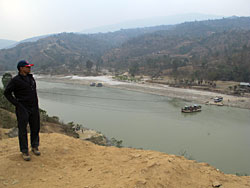 British development consultant, Bharat Patel, at the site of one of the two bridges RAP is building over the Arun River. |
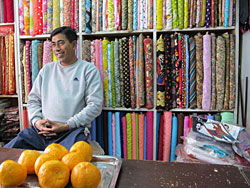 Bhojpur trader Dhruba Shrestha says the RAP road has raised living standards and increased the purchasing power of his customers. |
At Bhamran on a new section of a RAP road to Dingla, Bibas Rai points out the fallow fields. Most young men have emigrated. "People think that if you are educated you shouldn't farm," says Rai, "but I am staying back, I will never leave. Someone has to grow the food."
To go or not to go
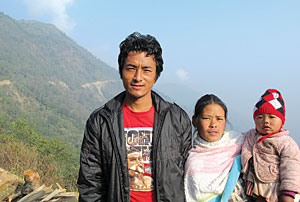 |
Lakpa is not so sure. He shows us his calculations on the back of a cigarette pack. He earned Rs 100,000 in the past year digging the road, and now he is enrolled in carpentry training so he can start a small furniture shop.
He has decided not to migrate for work. "I will never go," says Lakpa, "I will toil and sweat in my own country."
"Water, water"
In the 1950s, when Swiss geologist Toni Hagen travelled the length and breadth of Nepal, he used to ask Nepalis what they needed the most. Many told him they wanted a bridge. The rivers were barriers, and bridges provided accessibility. In the 1980s, most Nepalis told him they wanted a road. Today, roads reach nearly every VDC in the country, and there are suspension footbridges across most rivers.
Here in Bhojpur, Nepalis have a new wish: irrigation. The road has brought income and access to market but farmers suffer a serious shortage of water in the dry season. This has been exacerbated by successive years of winter drought.
Till five years ago, Matrika Adhikari of Syauli village couldn't even grow enough to feed the family. Today, he is sending Rs 150,000 worth of Akbare chillies by road to the Druk pickle factory in Sunsari. Says Adhikari, "We could grow anything if we had irrigation."
READ ALSO:
Every drop counts
"Peace, governance, development?"
RELATED STORIES:
Jumla's road to the future, KUNDA DIXIT in JUMLA
The great green road, PRAGYA SHRESTHA
The road ahead for Nepal, PRAGYA SHRESTHA