
 This week, the world’s largest democracy celebrated the 66th year of promulgating its constitution, the longest written guiding principle of any nation on earth.
The celebration that showcased the military might and cultural richness of this emerging power was witnessed by the most powerful man in the world -- indicating India’s rise to the global pedestal. We in India’s backyard watched with envy.
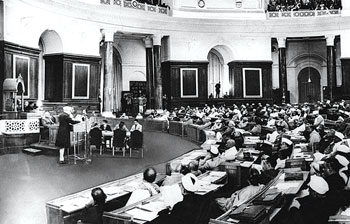
The Indian constitution took 165 days of intense debate spread over 11 grueling sessions in the Constituent Assembly (pic), out of which 114 were devoted to discussion on the draft constitution. Today, 65 years later, the Indian Constitution contains 448 articles in 25 parts, 12 schedules and 5 appendices with 98 amendments made so far.
Despite huge differences in size, economy and political history we in Nepal can learn some lessons (and pitfalls) from the Indian constitutional exercise. After all, the Indian union (they deliberately didn’t want to call it ‘federation’) has been grappling with its own share of constitutional fault lines.
In its final session before the promulgation, the chief architect of the Indian constitution BR Ambedkar had warned: “On the 26th of January 1950, we are going to enter into a life of contradictions. In politics we will have equality and in social and economic life we will have inequality. In politics we will be recognising the principle of ‘one man one vote and one vote one value’. In our social and economic life, we shall, by reason of our social and economic structure, continue to deny the principle of ‘one man one value’. If we continue to deny it for long, we will do so only by putting our political democracy in peril.”
Over the years, these fissures widened as the Indian union faced identity movements in its southern states demanding linguistic rights, while nationalist insurgencies in Telengana, Assam, Manipur and Nagaland dragged New Delhi to war against its own people.
Ambedkar saw it coming. In his view, without social democracy at its base political democracy has little chance of succeeding. If anything, the custodians of the Indian constitution seem to have ignored the words of this Dalit intellectual who had no illusions about the limitations of the document he had penned.
Making a scathing critique of patriotic nationalism, Ambedkar had warned: “I am of opinion that in believing that we are a nation, we are cherishing a great delusion. How can people divided into several thousands of castes be a nation? The sooner we realise that we are not as yet a nation in the social and psychological sense of the world, the better for us. For then only we shall realise the necessity of becoming a nation and seriously think of ways and means of realising the goal.”