
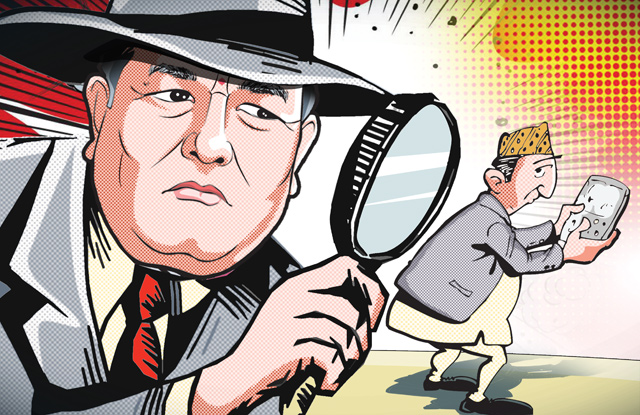
When 157 UML-Maoist MPs registered an impeachment motion against the CIAA Chief Lokman Singh Karki in October, they accused him of abusing his authority and committing crimes against the state.
One of the nine charges against Karki is that he unlawfully snooped on political leaders and security chiefs by collecting their call details and tapping their phone calls.
Phone tapping is illegal, and even police are not authorised to intercept calls even though the Narcotics (Control) Act 1976 and the Prevention of Organized Crime Act 2013 allow them to do it during the investigation of certain cases.
How did Karki gather the wherewithal and the authorisation to listen in to the phones of politicians, businessmen, journalists, lawyers and civil society activists? Parliament could investigate this, but hasn’t.
However, after Karki’s suspension government agencies and security officials who were earlier afraid of him are now spilling the beans. They are giving details of the elaborate surveillance network that used to be directed by Karki from his headquarters in Tangal.
It was standard practice for the Home Ministry to second 100 selected policemen to duties at the CIAA. But after Karki’s appointment he started to personally handpick senior officers and policemen for positions at the CIAA. He prepared his list of 250 personnel, got it endorsed by the Home Ministry and inducted them into the CIAA headquarters turning it into a barrack.
Shortly after becoming the CIAA Chief, Karki used an inspector to spy on the publisher of an influential newspaper. But the inspector refused and somehow managed to get transferred out of the CIAA. Since then, Karki started working only with policemen he trusted and personally picked.
Karki sought budget from the Ministry of Finance to set up a state-of-the-art surveillance system, and chose police officers with training in electronic surveillance. “The fact that he chose the best of our surveillance officers shows that Karki was up to something sinister,” said a police AIG. “There is enough evidence that he intercepted calls of leaders, but what we do not know for sure is whether he did it from his own office or through telecommunication companies.”
Police are allowed to rely on telecommunication companies to trace calls, SMS and geo-locate suspects in criminal investigations. But the constitutional provision on the right to privacy does not allow them to intercept and tap phone calls.