
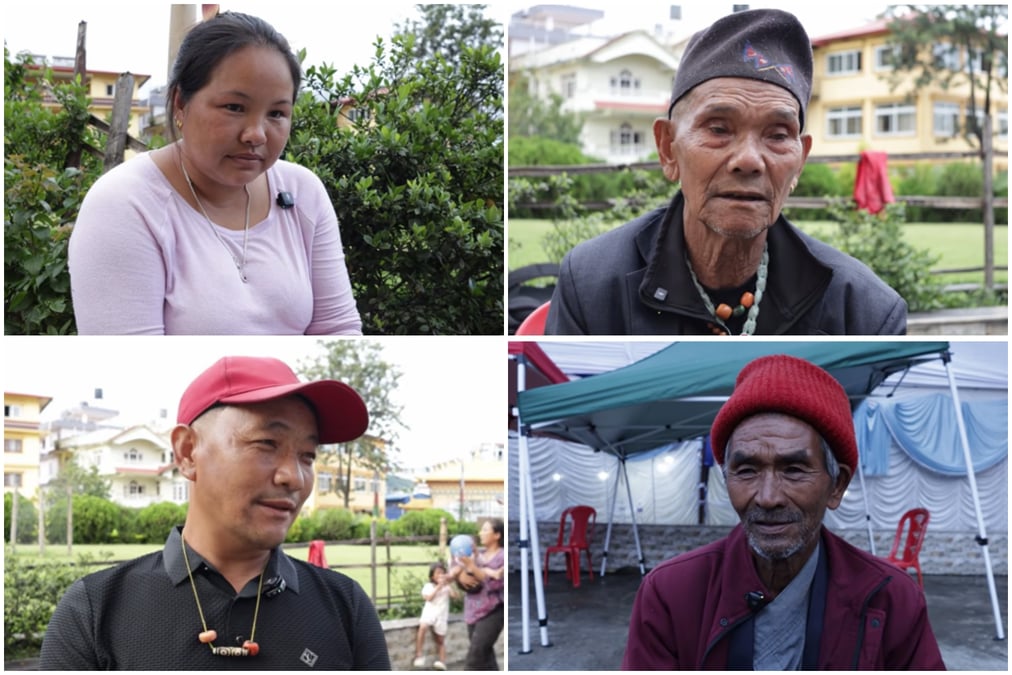
Two weeks after the massive Trisuli Valley flood, tens of thousands of displaced people are living in tents, or with relatives and friends. Hundreds of others from Syaprubesi have found refuge at the Gosok Phuntsok Choeling Monastery.
Known as the ‘Yellow Monastery’ in Kathmandu, the complex had also served as a shelter for survivors of the Langtang earthquake-avalanche in 2015. Eleven years later, the rock-ice collapse on the north face of the same mountain has sent another flood of refugees here.
There are elderly men and women counting prayer beads, children and infants and entire families who have nowhere to go. Monks and staff here provide food, basic accommodation and other necessities from the monastery’s own resources.
Shanbu Sherpa
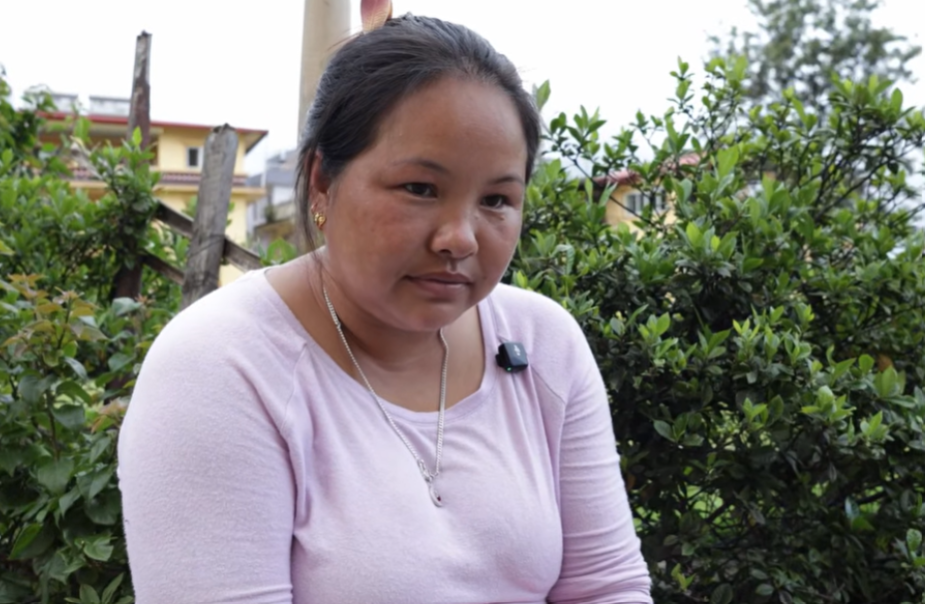
At about 8:45AM on 26 August, Shanbu Sherpa was preparing breakfast for her family. She worked as a caretaker at a school, and had come to Syaprubesi during a two-day break.
The sky was blue with wisps of white clouds draping mountaintops, just like in thangka paintings. The monsoon seemed to be winding down.
The water of the Bhote Kosi was clear again as it tumbled over boulders. Some buses and hired jeeps carrying tourists and pilgrims had spent the night, prepared to leave for the Chinese border 15km upstream.
The morning bus to Kathmandu was honking for passengers, ready for the nine hour journey. There was nothing to warn anyone about what was about to happen.
Suddenly, there was a deafening roar from the direction of the Chilime hydroelectric powerhouse, and Sherpa’s immediate reaction was that it was a repeat of the 2015 earthquake which had sent rockfalls down to Syaprubesi. Last year’s flood on the same river had also arrived with a roar like this.
“We ran outside thinking an earthquake had struck,” she says.
Soon, a gigantic brown wall of sludge appeared around the bend in the river rearing like a cobra head and approaching at incredible speed.
It was preceded by a strong cold wind. Multi-storey houses were battered and swept away like matchboxes, debris was flying through the air.
Sherpa has a paralysed leg and realising that she could not outrun the flood, shouted for her children to climb to higher ground and save themselves.
“I told my 16-year-old son, ‘Go. I cannot run. I will die here’, she recalls.
Her son refused to leave his mother behind: “He told me, ‘No, mother, even if I die, I will save you first.” He then carried her to safety just in time as the flood raced past.
“I did not think I would survive,” Sherpa says, safe now at the Yellow Monastery with her husband, daughter and two sons. She has lost her home but does not want her children to lose their education.
“I have nothing left at home. I only want my children to be able to study,” she says. “I appeal to the government to make arrangements for their education.”
Chesang Ghale
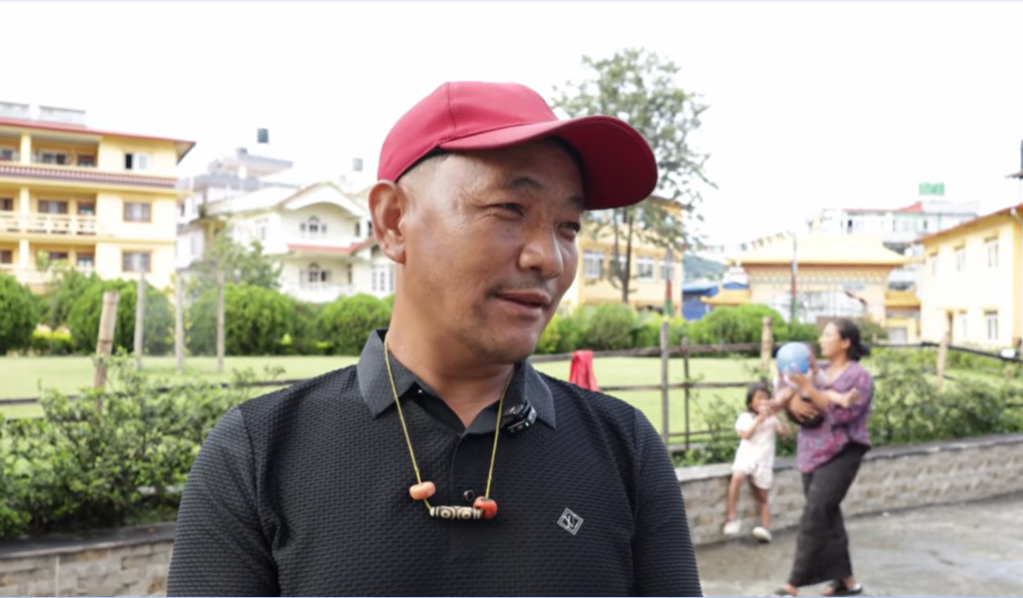
The flood reached the courtyard of Chesang Ghale’s house and took half of it away. He managed to climb up the slope and save himself, watching his younger brother being swept away. He is still missing.
Ghale says, “We are here at the monastery temporarily, now it is up to the government to make proper arrangements for us and other affected families.”
If the flood had come at night, a lot more lives may have been lost here in Syaprubesi and down the valley. The flood took away the entire lower part of the town, and only the houses on the upper slopes remain. Even the village monastery was partially inundated.
Mingmar Lama
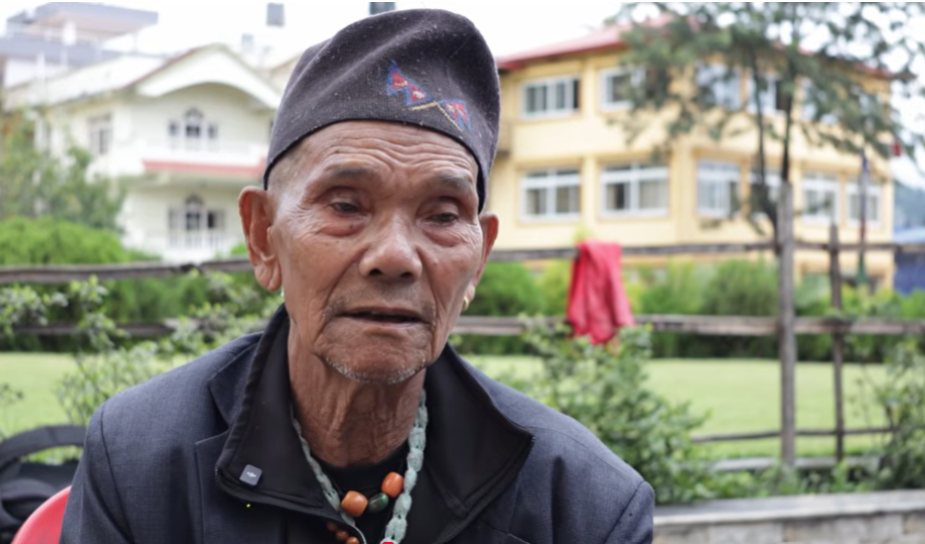
At 89, Mingmar Lama is waiting for news of his son and younger brother, who were swept away by the flood. His house was destroyed, and not a single possession could be retrieved. He also lost six goats and 28 chickens.
“I don’t know what to say anymore,” he says. “I have no idea where my son and my younger brother are. There is still no news of them. What could I do? The flood came all at once.”
Lama barely managed to escape as surrounding buildings started collapsing, as the flood rushed past. “My son was taken. My brother was taken. I couldn’t save even one item of belonging.”
Lama was brought to the monastery in Kathmandu wearing the same clothes he had fled in. For now, he has food and a place to sleep. But he is haunted by nightmares, and he does not know what comes next.
“For now, they are looking after us. But what about tomorrow? What will happen the day after? I don’t know,” he says.
Kami Ghale
Only two walls remain of 75-year-old Kami Ghale’s home in Syaprubesi. The family was preparing a meal when there was loud shouting outside. “We were cooking when we heard the noise, so we dropped everything and ran uphill,” he recalls.
That instant reaction saved their lives. Others who tried to collect belongings were not so lucky, such was the speed at which the flood ravaged the town.
Ghale and his family were finally evacuated by helicopter to Dhunche and then down to Trisuli and to the Yellow Monastery by bus. “Our fields are gone with all the crops. What will we eat? Everything is gone,” he says with a faraway look.
Ghale and his family have been here for two weeks, but it already feels like two months. He reckons they will all have to wait until the road to Syaprubesi is repaired. All he wants is to go back home, or what remains of it.
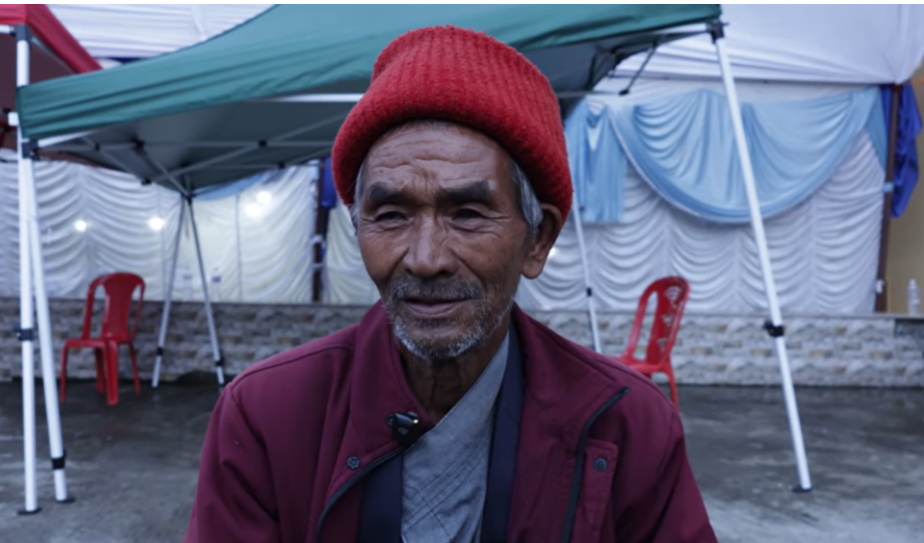
“How long can we depend on someone else’s charity?” asks Ghale, for whom the loss goes beyond just his house.
“Whatever condition it was in, it was still our home. It is the place where we were born. I saw it the entire town being swept away right before my eyes.”
Besides being the birthplace for many, Syaprubesi was also the gateway for trekkers going up to Langtang Valley, and also the stopping point for pilgrims on their way or returning from Lake Mansarovar in Tibet.
Many of those who perished in the flood were Hindus and Buddhists from all over the world on their way to the holy lake.
Besides tourism, Syaprubesi located at 1,500m elevation was also booming because of at least three hydroelectric plants being built nearby. It was teeming with construction workers, engineers, and the staff quarters were located along the river.
Although the population of Syaprubesi and Timure village 10km upstream has increased in recent years with visitors and construction workers, most residents are elderly and the younger generation has moved to the city or abroad for better prospects.