
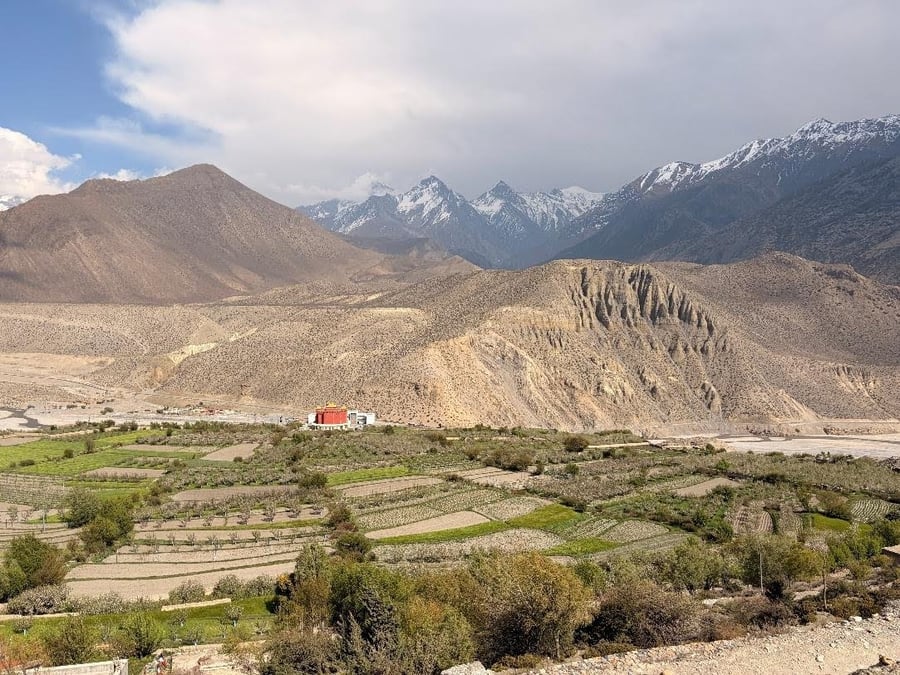
Spring gives way to a rainy monsoon, and then autumn arrives in a quiet, spectacular way. Apple orchards are heavy with fruit below a rugged trans-Himalayan landscape.
For tourists who flock to Mustang in this season, this is a breathtaking sight. For locals, however, apple trees sagging with fruit tell a story of climate uncertainty, shifting livelihoods, and demographic change unfolding in the mountains of Nepal.
Apples were always central to Mustang’s economy and identity, and this more true today than ever before. Cultivation has gradually expanded to higher elevations as temperatures rise and precipitation patterns change.
“Apple cultivation has prospered in these upper areas now. Earlier it was good mostly around Marpha, Tukuche and Jomsom,” says Triple Gurung, a hotelier in Kagbeni. “Farmers here here believe it has to do with rising temperatures.” His observation corroborates what what scientists have been saying about the Himalaya warming 0.7 degrees Celsius faster than the global average.
Climate breakdown has also made this arid region wetter in summer and there have been many years with winter drought. Farmers in Kheenga has noticed this erratic weather, and say that heavy unseasonal rain damages apple blossoms, and the fruit harvest is affected.
OUTMIGRATION
Despite these uncertainties, better road connectivity and market linkages with urban centres like Myagdi and Pokhara have helped apple farming thrive in recent years. But these changes also coincide with significant demographic shifts in the Kali Gandaki Valley. Many youth and working age individuals from the Thakali and Gurung communities have migrated to the cities and overseas, leaving behind an elderly population and a major labour shortfall.
Today, much of the work sustaining Mustang’s orchards and agriculture is carried out by Dalits and migrant workers. Migration is not new in Mustang, what is new is its scale.
Seasonal migration was once driven by the need to escape the long, harsh winter in the trans-Himalayan plateau. Today, it is increasingly aspirational, for education, employment, and economic opportunities.
While many have left, Mustang’s Dalit communities have remained, continuing to sustain the local economy, even as their histories and contributions remain overlooked in dominant narratives about Thakali and Gurung communities in Mustang.
Dalits are no newcomers to Mustang. Many households can trace their families’ presence here back to four or five generations, settling through their traditional occupations and labour rooted in हात को काम, the ‘work of hands’. Over generations, they have played a vital role in Mustang’s economy through skilled and manual labour making them an integral part of the social and economic landscape.
Their hereditary caste-based occupations have gradually diversified into daily wage labour, tourism services, and other non-farm work in recent years. Their lives, however, have unfolded alongside a long history of caste-based exclusion.
Older Mustang Dalits recall how social stigma once structured their everyday life. Says Ram Bahadur BK, “We did all the work with our hands, but these same hands were regarded as being impure.” Indeed, Dalits here as elsewhere were regarded as being ‘untouchable’.
Another 48-year-old Dalit woman farmer recalled that decades ago, her husband crafted and sold utensils, yet the communities would perform purification rituals before using them.
While education and increased literacy has been a equaliser, yet many Dalits have to make a choice between pursuing studies or work to support their poverty-stricken families.
“If we had studied, we could have more job opportunities. We didn’t study so we continue to work as labourers … caste and education still matter a lot,” says Rita BK, 37.
Fifty one-year-old Maya BK relates a similar experience: “I couldn’t continue my studies because our household was poor and my father was working by himself. I started helping him out when I was 12 because we needed money for rent and food.”
Over time, caste hierarchies have begun to shift in Mustang. Economic interdependence, migration, tourism and increased social interactions have all contributed to blurring the rigid lines of caste and untouchability. Political transformation, particularly after the Maoist movement and the promulgation of Nepal’s Constitution.
The influence of Buddhism which does not have such high rigid caste hierarchies contributed to reducing discrimination. Some Dalits have also integrated culturally, embracing Buddhism alongside local traditions and practices.
“My brother became a monk which earned respect and admiration here,” says Sunita Sunar from Dhakarjong. Overall, the younger generation of Dalits face fewer social barriers than their parents did, with many prioritizing education and personal growth.
Yet this social inclusion has not translated into economic mobility. The historical exclusion of Dalits from education, land ownership and other rights has significantly limited their access to better opportunities across generations and continue to shape opportunities today.
Traditional occupations such as utensil making are no longer economically viable, while limited access to skills training, financial capital, and support networks restrict alternative livelihood options. As a result, many Dalit households who stayed back remain tied to wage labour in the apple orchards and the service industry, supporting Mustang’s economy.
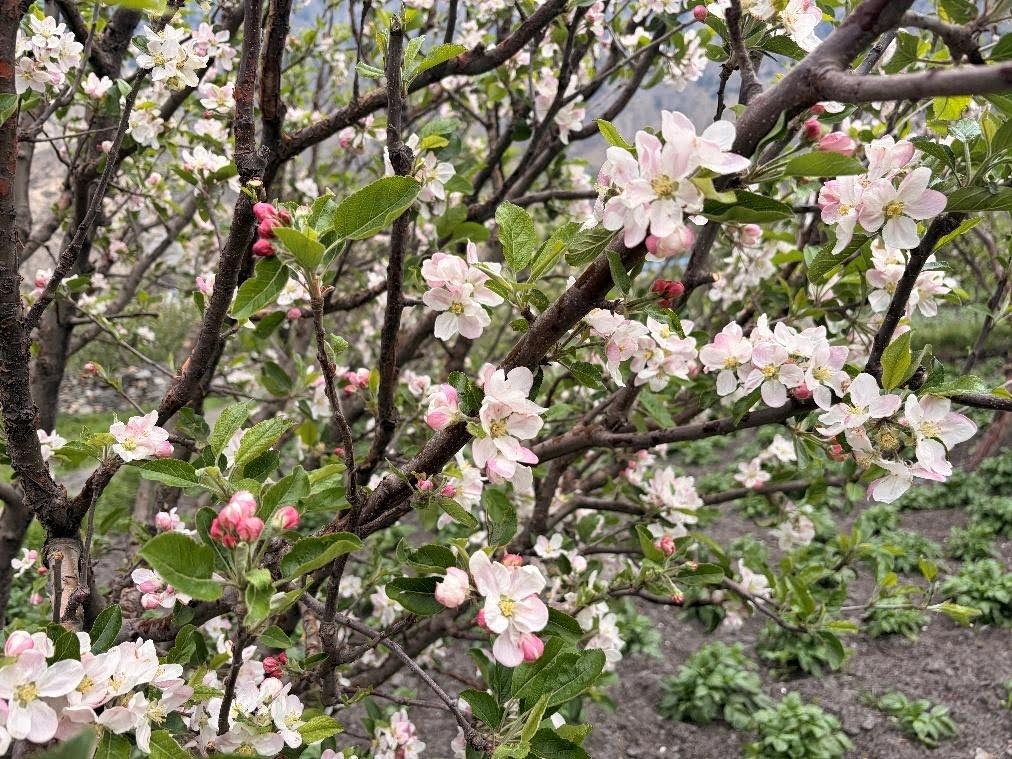
Behind the apple blossoms in Mustang are the unseen hands that have shaped and sustained these landscapes for generations. As this region navigates an uncertain future shaped by changing climate and demography, the pivotal question is not who leaves but who remains.
While Dalit communities gradually integrate into Mustang’s social and cultural fabric, the challenge now is to ensure that they are no longer the ‘left behind’ in the region’s development aspirations.
Simran Silpakar and Sunayana Basnet are both with the International Centre for Integrated Mountain Development (ICIMOD) in Kathmandu. Some names have been changed.