
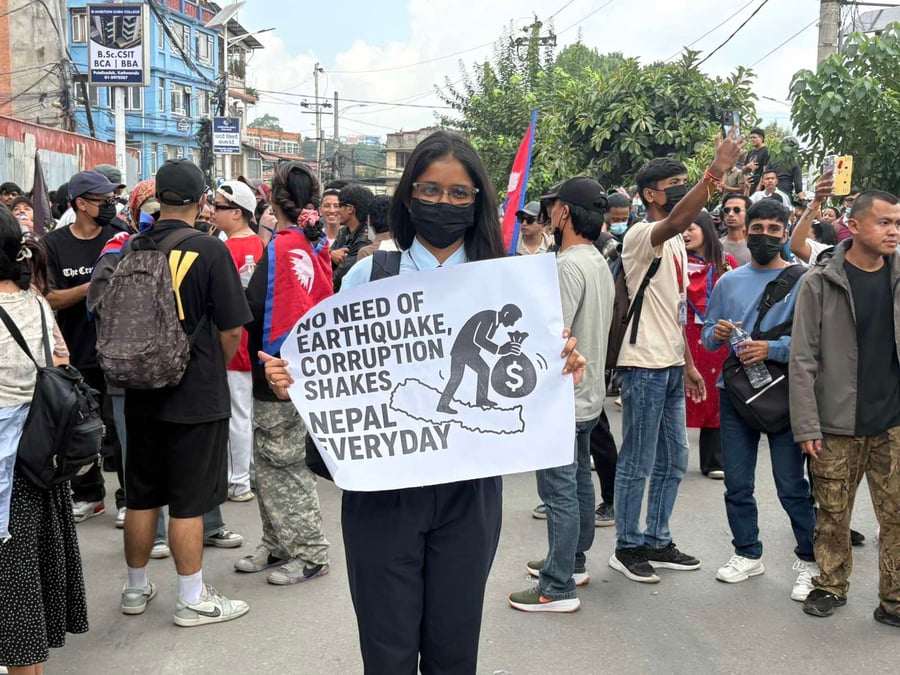
In the aftermath of Nepal’s September 2025 GenZ protests, a quieter question has begun to take shape: what next?
It is a question weighed by grief over the death of 78 young Nepalis in two days of violence on 8-9 September last year. Many families are grieving, yet the rupture also produced something more difficult to dismiss than outrage: public insistence that Nepal's governance structure and conduct needs to change.
Participants on a civic platform, 100 Days Nepal, were asked one question: If you could decide a single action for Nepal’s next 100 days, what would it be?
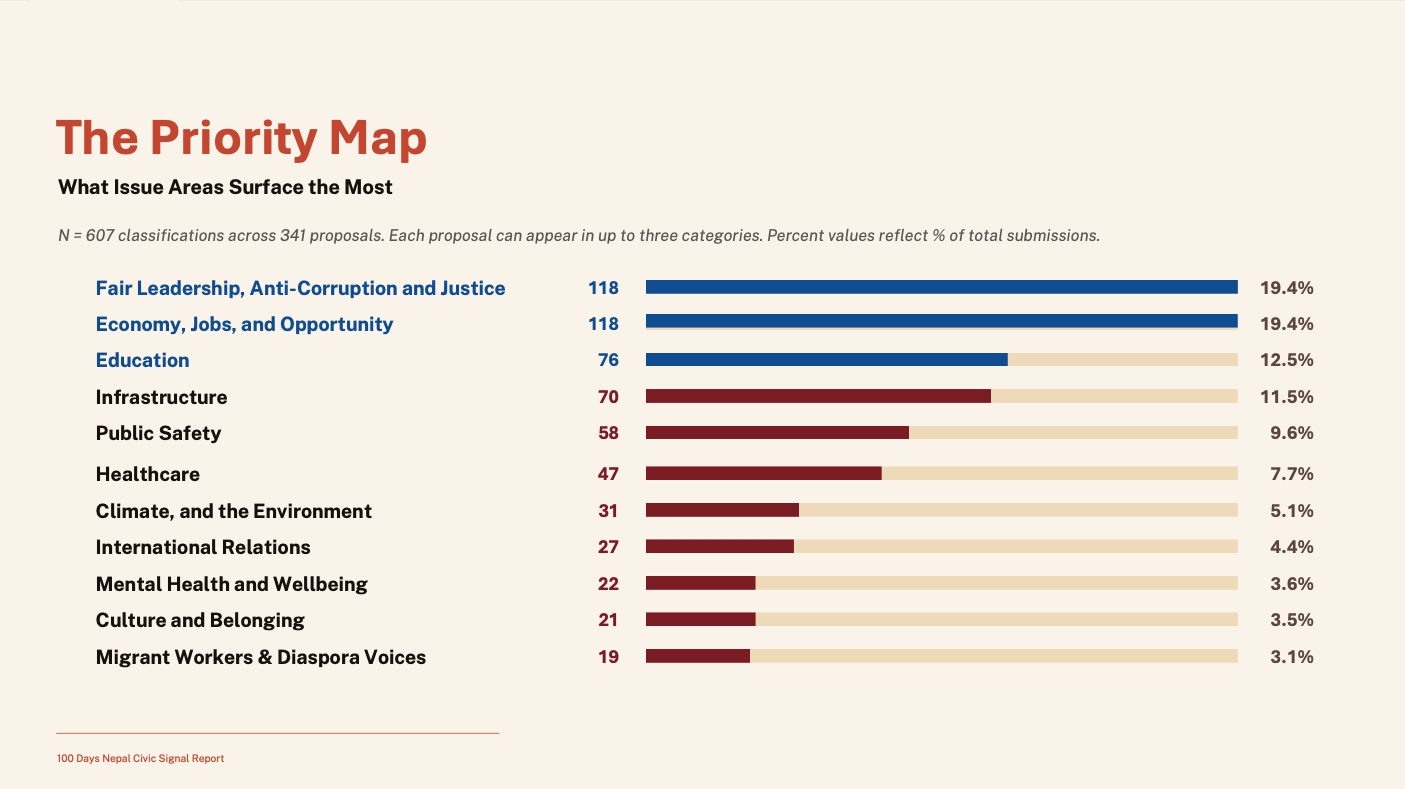
Taken together, the platform’s 341 proposals reveal public expectations, and the strongest themes were familiar burdens in Nepal’s public life. One in five responses concerened fair leadership, anti-corruption, and justice. The economy, jobs, and better opportunity were the most frequently selected issue areas.
Education followed, then infrastructure, public safety, and healthcare (see graphs). The pattern suggests that participants are not treating governance as an abstract ideal, but are measuring it through the architecture of a liveable future: work, roads, schools, safety, hospitals, and credible systems.
One respondent wanted a civil service accountability system built around job standards, regular evaluation, and citizen feedback. Another called for short-term skills training, a centralised job portal with verified listings, internships, and small-business support. Others asked for election literacy, women’s safety programs, stronger infrastructure, and more transparent public systems.
In moments of political crisis, public anger is often described as anti-establishment. The proposals gathered by 100 Days Nepal point to a more demanding form of public expectation: participants want accountability that is not limited to punishment. They want transparency, not only speeches. They want opportunity, not just slogans about youth empowerment.
For the 70% of participants inside Nepal, the emphasis fell heavily on immediate delivery. Their top priorities were the economy, education, jobs, and opportunity, fair leadership, anti-corruption, and justice.
Their answers reflect the pressure of daily proximity to problems. When institutions fail, the consequences are not theoretical. They appear in the search for work, the quality of schooling, the reliability of services, and the sense that public life is not functioning effectively.
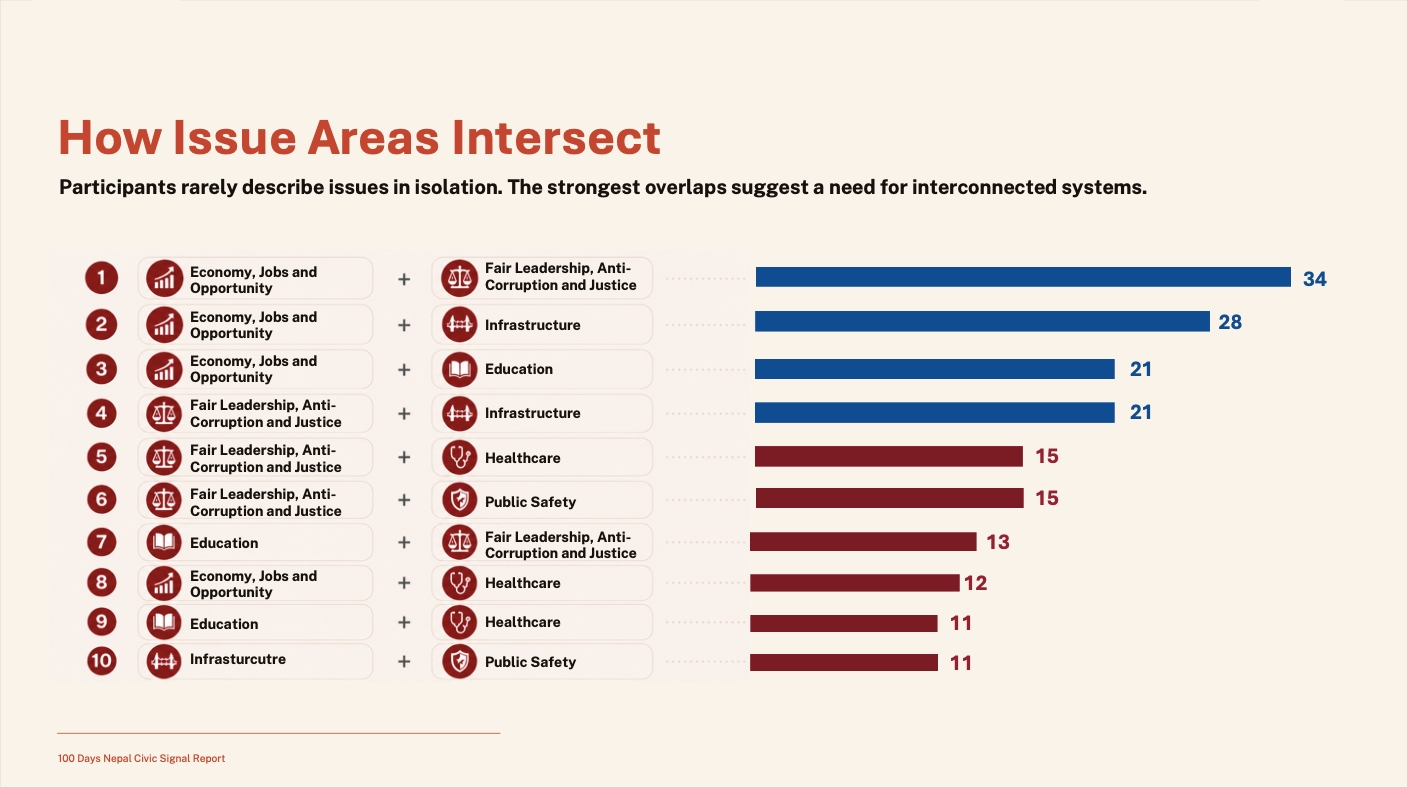
That explains why economic proposals intersect strongly with infrastructure, education, and anti-corruption. A job portal matters because young people need work. Skills training is important because people need income. Roads, healthcare, and safety matter because they shape everyday life. Education alone does not guarantee mobility.
The language of the submissions is full of systems: verified job platforms, public road maps, accountability processes, legal response systems, civic education programs, and more. This is not the vocabulary of passive hope. It is the language of a generation asking how power will be tracked, how jobs will be accessed, and how public institutions will be made answerable after the moment of protest has passed.
Their demand is not for one reform, it is for a state that can connect its promises to a better lived experience. Nepalis want mechanisms that will deliver.
JOBS, JOBS, JOBS
The emphasis on jobs is especially telling because economic opportunity is rarely separate from trust. A government that cannot create work is not simply failing economically, but institutionally. For many young people, the inability to imagine a viable future at home becomes an indictment of the state itself.
About 29% of submissions came from outside Nepal, including cities like San Francisco, London, Seoul, and Sydney. Responses from the diaspora carried related but distinct emphases. Nepalis abroad also cared about jobs and governance, but their responses were more about institutional access: voting from abroad, embassy accountability, and structured ways to contribute expertise.
For overseas Nepalis, the question is not only if the nation remembers them, but whether it has built credible channels for their participation. Belonging appears to be defined more by access to state functions than by symbolism.
Because this was an online survey, lower-access populations with less English-dominant voices are underrepresented. The metadata is self-reported and not independently verified. The analysis is thus interpretive, and serious reading of the findings has to resist the temptation to treat it as the voice of the nation.
Even so, they do represent the expectations of Nepali youth. The submissions show how young, digitally engaged Nepalis are thinking after the September Storm: they want proof that the old order has been interrupted. This is not, and should not be read as, a checklist of demands, but a a map of where trust has broken down.
In the first 100 days, the credibility of leadership may be defined by the visibility of action. In the months after, it may depend on whether services begin to work better. Over the long term, it will depend on whether reforms become embedded in rules, budgets, routines, and institutions strong enough to outlast individual leaders.