
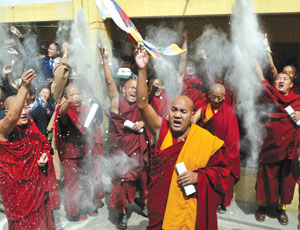
 CHONG ZI LIANG 49 Tibetans have already set themselves ablaze this year, compared to 13 who self-immolated last year. |
It is an eloquent testimony to our skewed priorities that we in South Asia devote reams of newsprint on the American presidential election and ignore the spate of self-immolations in Tibet. From February 2009, in 63 instances of self-immolations, 52 Tibetans have died. Those who survived were whisked away to hospitals, from where most of them never returned.
This tragic but unique form of protest against the Chinese repression has escalated over the months: 49 Tibetans have already set themselves ablaze this year, a shocking increase from the 13 who self-immolated last year. Most of them were between 17 and 30 years old, testifying to the persistence of their alienation despite the concerted attempts of the Chinese government to compel them to integrate into its system.
Most chose to set themselves ablaze outside famous monasteries or public places. Their choice of venue suggests the self-immolators consciously sought to turn their death into a public spectacle, in the hope of conveying to both the people and police the meaning of their action. Yet the audience could not interpret their action in any way other than as a protest against the Chinese government, for they shouted, as they turned into a raging ball of fire, slogans for freedom or demanding the return of the Dalai Lama to Tibet.
Some self-immolators chose to record their statements before walking to their chosen site of death. In their English rendering, these testimonials are remarkable for the absence of fear of death in them and their expression of anguish at the repression their people.
I accessed a few of these suicide notes, which almost always articulate concern over the cultural identity of Tibetans and wish a long life for the Dalai Lama. Typical is the statement Nangdrol recorded before self-immolation on 19 February: "Wear Tibet if you are Tibetan;/Moreover, you must speak Tibetan;/Never forget you are Tibetan; …/Restraint from taking lives of living beings/ May His Holiness the Dalai Lama live for many ten thousand years."
Three additional conclusions can be drawn from these recorded statements. One, there exists at least a rudimentary network to record and transmit the statements of self-immolators worldwide. Two, Tibetans don't consider self-immolation as sin, it is in fact extolled. Three, each self-immolator seems to inspire others to emulate him or her.
All this has prompted many to demand that the Dalai Lama should express his disapproval of self-immolation, believing such a proclamation could dissuade those contemplating to voluntarily embrace fiery death. Others, like Stephen Prothero, a scholar of religion in Boston University, have questioned the silence of westerners over self-immolations in Tibet, particularly as suicide bombing seems to repulse them. This is precisely the logic the Chinese have extended to dub self-immolation as terrorism and claim it violates the tenets of peace and compassion enshrined in Buddhism.