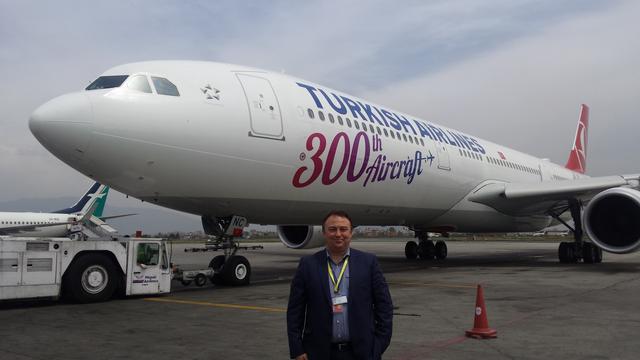
Turkish Airlines this month marks its fourth year of operations, connecting Kathmandu directly with Europe and through Istanbul to the rest of the world. The airline has now increased frequency to five times a week. Nepali Times spoke to General Manager for Nepal Abdullah Tuncer Kececi about the challenges and opportunities. Excerpts:

Nepali Times: Has load factor on Turkish Airlines Kathmandu sector now returned to pre-earthquake levels?
Abdullah Tuncer Kececi: Turkish Airlines started flights to its services in Nepal in 2013 September and has been promoting Nepal as a tourism destination from the beginning. We are celebrating the fourth anniversary of connecting Nepal to the rest of the world.
The number of people travelling to and from Nepal went down almost 40% after the earthquake, but it has been picking up again. We believe, promoting Nepal as a tourism destination will also help to recover quickly. Tourism industry is one of the main incomes for the country. You can see Turkish Airlines in all tourism fairs such as WTM London, FITUR Madrid, ITB Berlin, IFTM Paris trying to promote Nepal.
We are not trying to get a big piece from the cake. We are trying to make the cake bigger for everyone. For us Nepal is more than mountains.
Which areas of the world are you focusing on for Nepal traffic via Istanbul?
It’s mainly Europe. We even celebrated 50 years of operation in some of our destinations in Europe. Our passengers know Turkish Airlines for the quality of its service very well. We have been awarded as Best European Airlines for six consecutive year and fly to 117 destinations in Europe. Of course it is not only Europe. We have 300 destinations all over the World. 9 cities in US, 5 cities in South America, 2 cities in Canada, 51 cities in Africa, almost all Asia countries as well.
What are the major operational bottlenecks for you in Nepal?
Nepal has great tourism potential. We have a target of 5 million tourists in Nepal. But everything must move parallel to reach this target. As everybody knows, there are some infrastructural problems we have to resolve. These are barriers for growth. Roads, airports, connectivity between cities, number of hotels, service quality -- all must move in parallel. We have only one international airport. The capacity is a major concern for us and all other airlines operating here. Kathmandu is not an easy destination because of heavy air traffic which force aircraft into long holding patterns. The airport has to be urgently upgraded and extended to meet growth targets for tourism.