
In Nepal’s over-politicised and polarised national milieu, it can only be a good thing that there will be fewer political parties – especially those of the Communistic persuasion. At one point after 1990, there were 17 registered Communist factions: from adherents of hirsute European philosophers of the 19th century, disciples of Comrade Vladimir Ilyich or Uncle Joe, those who admired Mao Zedong so much that they didn’t just emulate his justification of mass murder but even copied his hair style, and those who still swear by Kim il-Sung.
After an ill-conceived war that left at least 17,000 Nepalis dead and devastated the country and its economy, the main Maoist faction has decided to form an electoral alliance with a party that, despite the ominous-sounding Communist Party of Nepal Marxist-Leninist name, is supposedly left-leaning.
Contrary to the usual tendency of Communist factions to prefer alliances with the far-right rather than to a party immediately to the right of them, the comrades have decided to work together. Into this grand alliance, they have also invited the chief Maoist ideologue, Baburam Bhattarai, who had been in the wilderness after having left the parent party.
It has become a habit here to be cynical about politicians, and that is because they have discredited themselves so badly since the restoration of democracy in 1990, and more so after the ceasefire in 2006. The fact that many of the main players are Brahmin men and relics from a generation ago doesn’t help in according them more public respect and credibility. Don't expect any progress on transitional justice from this lot. Nepal is now effectively going to be a bi-partisan state and elections will be a two-horse race.
In spite of all that, we still believe the left alliance of the UML, Maoist Centre and the New Force is a positive step. If it can withstand greed and ambition after the November elections, and if it has visionary and cooperative leadership there is chance that this could indeed lead to the greater political stability that is needed for Nepal’s long-awaited great leap forward. That is a lot of if’s.
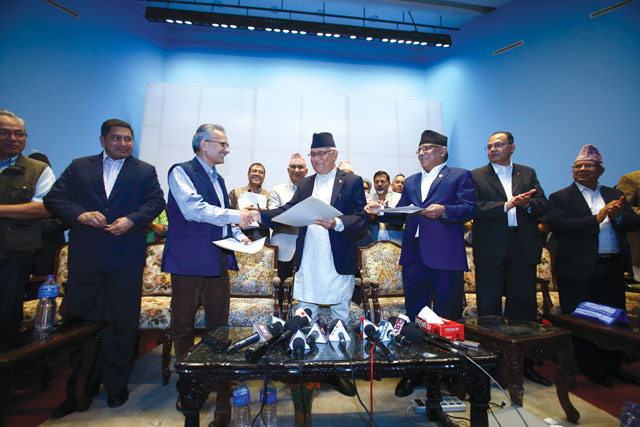
In their raucous pact-signing on Tuesday evening at the Nepal Academy, the three parties agreed to first join hands in dividing up tickets for election candidates on a rough 60:40 ratio, and ultimately to unite the three parties. The aim seems to be to ensure a two-thirds majority in the new Parliament so that legislative negotiations and passing future amendments to the Constitution will not be deadlocked, as they are now.