
 BIKRAM RAI |
She ran her hand along the long, curving banister, and announced loudly: "The raja-rani must have touched this sometimes, too." The grand staircase, flanked at the bottom by a pair of stuffed tigers teetering on their hind legs, led back down to the main entry at the end of the tour of the Narayanhiti Palace Museum. The young woman's sentiment was one that many Nepalis have indulged in since the last king of Nepal moved out. How did the Shah kings actually live? And by visiting the palace, can one partake of their rapidly fading history?
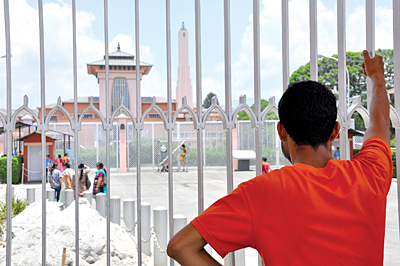
I'd steered clear of this vicarious experience until quite recently. There always seemed something worthier, or at least more enjoyable, to do. And the Shahs, after all, never had a reputation for fantastic wealth, or even good taste. The towering pink folly that faced onto Darbar Marg and the constant line of people clutching sticky ice-creams were deterrent enough. Until one Saturday afternoon I had an hour to kill, and nowhere to go. Jau raja ko ghar, someone said. Never invited, we paid to get in.
The palace is unremarkable, in case you were wondering. Especially compared to its counterparts across the globe. What could one expect inside a boldly designed but ultimately tasteless structure from the 1960s, commissioned by a Shah king given free reign to indulge after the neo-classical grandeur of the Rana palaces?
We walked through room after room named after districts in Nepal, filled with diplomatic tat from all across the world, furnished in a middling luxury that has inadvertently become retro-chic. These were linked by corridors leading past plain-jane bureaucratic instalments of lockers and plywood doors, and culminated in the repulsive, laughably conceived throne hall. Nothing could be more uninspiring; it's hard to believe, in fact, that the monarchy was ever held in such awe, until of course you consider how poor most of the rest of the country was and still is.Apologists might say Rukum and Rolpa weren't really neglected by the Shahs: the rooms whose names they bear compete with each other in the quality of their chandeliers.
Yet for the Nepali visitor at least – and I saw none but Nepalis, mostly working and lower middle class folk – the brief tour of less than an hour is compelling. Because the monarchy is such recent history, there is something voyeuristic about peering into rooms and visualising Birendra or Gyanendra (take your pick) taking a nap or perusing the latest district development reports (stacked up impressively in the study). Did the child Dipendra ever run through Myagdi and Parbat to peer at his father, who he might have been warned (by his mother) not to disturb on any account? Did he come across the late monarch amusing himself by flicking the globes on either side of his desk, and think, "That's what I want to do one day"?
At any rate, we can see what Dipendra made of his home in the end. The foundations of the now demolished outbuilding where he mowed down his family, precipitating the eventual abolition of the institution he only presided over in a coma, provide a sobering coda to the tour. Here there are bullet marks drilled into the walls, and here is the fountain next to which Dipendra's body was found. Behind, there is a ramshackle, overgrown garden, from where you can imagine flocks of birds shrilled into the sky at the first burst of automatic gunfire.
How must Gyanendra have felt when he left the palace? It could hardly have seemed like leaving a home, because this was never to be his rightful seat. It must, however, have seemed like a dreadful ignominy to have to leave the place that commemorated his dynasty. Bereft of royals, Narayanhiti Palace is simply a junkshop of mediocre art. But it is still possible, if you find yourself in a quiet corner, to imagine how it must have been before the fall. When kings were gods, life must have seemed simpler, and Nepal's problems less insurmountable. NB: Visit narayanhitipalacemuseum.gov.np/ if the hackers will let you.