
|
|
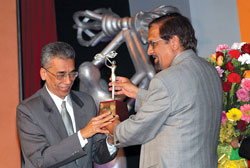
| LOOK WHO'S BOSS: Padma Jyoti of the Jyoti Group receiving the boss Lifetime Achievement Award from Finance Minister Ram Sharan Mahat on Wednesday. |
Big businesses are rarely celebrated in Nepal. First, there's the perception problem. Most are seen, often without good evidence, to be corrupt and discomfortingly close to those in power, and to most educated Nepalis in non-private sector jobs, the phrase 'big businessmen' unfairly conjures up images of smooth-talking hustlers or middlemen who make money by fleecing innocent customers and producers.
And second, while almost all political parties are quick to announce various job-creation policies, they remain incapable of understanding that greater good can only come about if the government is confined primarily to the role of enforcing the existing rules fairly, while allowing many competitive small and large businesses in all sectors to play out their sagas under the watch of a fearlessly independent business press.
For the past six years, the boss monthly magazine has worked hard to change the negative perceptions surrounding members of the business community. It has chronicled the success of Nepali entrepreneurs, bankers and managers, giving the next generation of businesspeople role models they can look up to.
On Wednesday, the monthly hosted a well-organized and well-attended 5th Business Excellence Award in which Nepali businesspeople, entrepreneurs, CEOs and management students, judged best in their respective categories, were given trophies.
But besides these perception problems and stories of excellence there remain two major constraints which are likely to hinder the growth rate of most Nepali companies in times ahead. One is the shortage of middle managers. The other is the rise of militant unions.
Shortage of middle managers: Most big Nepali businesses are family enterprises which are slowly learning the value of hiring professional management talent. While senior managers remain much in demand, there is a severe shortage of middle managers who can carry out day-to-day functions without much supervision.