
 MJOSHI.BLOGSPOT.COM |
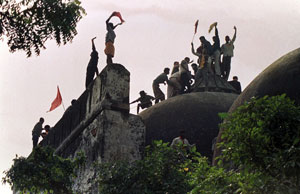
His voice trembled as he said: "It is happening in Ayodhya. They are demolishing the Babri Masjid." At those words my late morning grogginess sloughed off, as did the chrysalis of innocence in which I lived, from which emerged another man who was to discover a world tucked beyond the then existing limits of political imagination. It was a world in which hatred was the language of politics and violence a legitimate, even righteous, expression of inexplicable indignation.
Wherever we were, and whatever our identity, the new imagination challenging credulity transformed each of us to the degree he or she was affected. Such was the cataclysmic nature of 6 December, 1992, forever etched in the annals as the day on which a medieval mosque in Ayodhya was demolished to undo the wrong of history. That 'that medieval structure', it was claimed, was built on the spot where had been born Lord Rama. To commemorate the date as the day on which the Babri Masjid was destroyed is to render banal its significance.
It was the day on which emerged in the Indian society a new faultline. The word 'they', as my friend had used, acquired another meaning. Who constituted 'they' and who 'we'? Religion was not always the factor determining membership to either of the two categories. You were 'they' or 'we' depending on your position on the Babri Masjid, whether you believed its destruction was a wedge driven into the very heart of India or, alternatively, an expression of Hindu resurgence, necessary as well as inevitable.
Across the fault 'us' and 'them' stood eyeball to eyeball, though not in Ayodhya – where on the rubble of the Babri Masjid was erected a makeshift temple and the town ultimately placed under curfew – but in conversations
conducted in our drawing rooms. 'Them' and 'us' wrote in the newspapers, openly making it known to which category they belonged.
The differences between the two groups were irreconcilable. It was thought pointless to engage members of the rival group in debate because it could have no closure. Soon suspicion seeped in; you avoided talking of the Babri Masjid, even politics, with those who you believed were on the other side. Such suspicion engendered possibilities of sundering friendships, for it was always a shock to discover a friend whom you had known for years belonging to 'them'.
I realised this in the months following the demolition of the Babri Masjid. An old college friend had come over home to spend an evening. Two days earlier, I had voted in the Delhi state assembly election, and the voter ink on my fingernail was still visible. My friend asked me whether I had voted the Congress or the Bharatiya Janata Party (BJP), which along with the parent organisation, the Rashtriya Swayamsevak Sangh (RSS), had spearheaded the anti-Babri Masjid campaign? I skirted around his question. He persisted, I stonewalled him. Exasperated, the friend muttered, "As long as you didn't vote the BJP, it is fine with me."