
 MIN RATNA BAJRACHARYA |
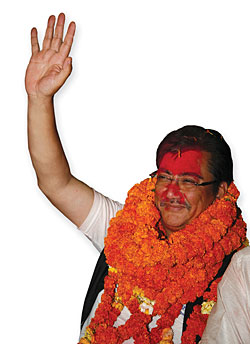
With all that red abir and khaada, were those the election victory celebrations of a business body or the student wing of a political party? That was the question going through my mind upon watching the TV footage of Suraj Vaidya's victory in this week's Federation of Nepalese Chambers of Commerce and Industry (FNCCI) elections.
The FNCCI bills itself as "an umbrella organisation of Nepal's private sector." But its working definition of that private sector is visibly narrow: a few family-run behemoths that have done well since the time the government handed monopoly licenses some 50-odd years ago, many large trading firms that import goods and sell locally at high margins, a growing number of businesses outside of Kathmandu that have been started by many locally influential jamindars, and various lobbying groups that push for pro-industry and pro-firm concessions.
Characterising the FNCCI as such is not to criticise it. It is to explain what it is.
As such, one should not expect FNCCI to advance the agenda of entrepreneurship, innovations, and bold thinking, such as by finding ways to better treat Nepal's migrant workers. Nor should one expect it to promote small and medium businesses that provide self-employment to many. Nor does one expect it to push for pro-market and pro-competition economic policies that call for a level playing field.
And so, given its nature and the expectations of members who will presumably want to extract their pound of flesh after having spent more than 50 million rupees on the elections, can there be a vision for the new FNCCI leadership? Yes, if Vaidya spends his three-year term focusing on these two critical problems facing the private sector.