
|
|
|
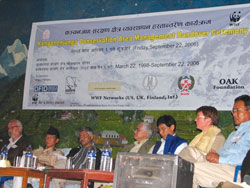
LEAVING A LEGACY: From right, Chandra Gurung, country representative WWF-Nepal; Jill Bowling Schlaepfer, director of programs, WWF-UK; Mingma Norbu Sherpa, conservation director, Asia Pacific Program, WWF-US; Narayan Paudel, director-general, Department of National Parks and Wildlife Conservation; Damodar Parajuli, acting secretary, State Ministry for Forests and Soil Conservation; Gopal Rai, state minister, Forests and Soil Conservation; Pauli Mustonen, Charge d'Affaires of Finland in Kathmandu on 22 September in Taplejung at the handover by WWF-Nepal of the Kangchenjunga Conservation Area to a local council representing dozens of village committees and mothers' groups. |
The Ghunsa helicopter crash last week that killed 24 people wasn't just a tragic loss of life, it devastated Nepal's nature conservation movement, setting it back by decades.
Many names on the passenger manifest were builders of Nepal's model achievements in environment protection over the past decade. Their deaths have left a void that will take a long time to fill. They proved that nature is best protected through grassroots ecotourism activities, and their projects are being replicated in Nepal and across the world.
"These people represented the diversity of expertise, backgrounds, and ethnicities that contributed to Nepal's conservation successes over the last 30 years.
They proved that for conservation to work you need strong local participation. and they would have made even more contributions. Their deaths leave a void that will take a long time to fill, particularly in terms of janajati participation and leadership," says Lhakpa Norbu Sherpa, who worked closely with many in the crash over for 25 years in Nepali conservation.
It is a bitter irony that just the previous day, they had all witnessed another landmark in Nepal's nature conservation history: the handing over management of the Kangchenjunga Conservation Area (KCA) to a local council. The initiative built on the main lesson of Nepal's conservation success, that the environment can be protected best when local people are involved.