
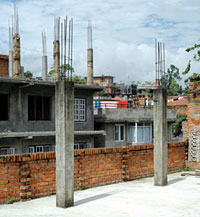
 There is more than one way to consider the concrete pillars that reach up to the sky from the tops of incomplete buildings all over the Subcontinent. One floor is built and the iron rods are left straining upwards, looking ahead to the day when another floor will be added. Perhaps that storey too will have more rods atop, indicating unfinished business, hope and perhaps avarice.
It seems that in large parts of our urbanising region a building is never complete. There is the expectation that the economy will improve, demand will kick in and a storey will be added. In this calculation, aesthetics is clearly not a priority.
Artistry and design is indeed a remote issue for the first generation of middle- to lower-middle class homeowners presented with the potentials of the 'pillar system'. The attraction is the wide indoor spaces that were never possible earlier in the era of mud, brick, tile and timber. As specific architectural elements like flooring, roofing, dividers and sidings are discarded in the age of cement, an entire store of what may be called dwelling vocabulary is being abandoned.
In the hills of parts of Nepal modern construction materials have led to the demise of the pindi (veranda), that familiar space for chores and conversation under the pali (eave), contained by the tham (pillar holding up the pali). Indoors, the nidal (main wooden beam) and the dalin (cross beam) are disappearing as are terms such as chota (the first floor) and buingel (the second floor and attic). As homeowners opt for flat roofs, the dhuri is also history, that sloped roof of tile, straw or grass.
The Southasian classes who can afford concrete are yet to adapt to living in cement boxes. The transition from mud floor, wooden supports and load-bearing brick walls has been too quick and drastic and the indoor quality of life has taken a terrible beating. Walking down Kathmandu's city core, one can see centuries of building design at one go-the mud-brick edifices with lattice-work windows from the era before glass panes, the buildings with lime-mortar pointing that hark back more than a century to when the technique arrived from Avadh and, finally, the buildings of cement-mortar that have been evolving since their appearance in the 1960s.