Kishorilal Aug 12, 2011
Short and snappy. Liked it a lot.
Kishorilal, London
KiranL Aug 13, 2011
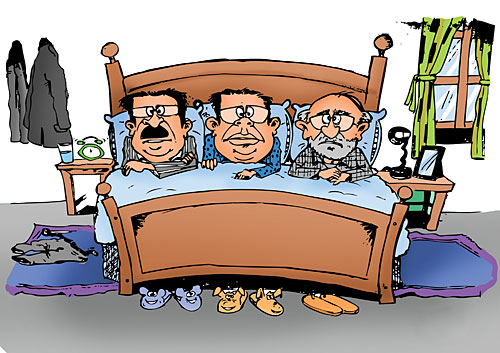
Loved the toon, so the threesome are in bed together. They need to agree on the CA extension so they'll do anything.
Ram Prasad Sharma Aug 13, 2011
Really, so what are we waiting for ? Why the delay ? Nepali politicos need to understand that the issues are about jobs for the unemployed, growth in economy and trade, creation of business, education, health and on and on. Lets see some real leadership, Nepal needs to stop being a beggar and only depend on foreign aid and remittance... we have enough God given resources in Hydro and Tourism ..just develop these... show some pride for Nepal and be proud to be a Nepali ...enough corruption, enough shame... its time for real change and real leadership.... are you up to the task, dear Mr. Baburam Bhattarai or are just like the rest of the pack ????????????
Soni Aug 13, 2011
The answer is pretty simple, they are waiting for nothing, they just don't know what else to do.
John Kelleher Aug 14, 2011
Is this a formal endorsement for Baburam as PM by the Nepali Times? It certainly reads like one. The fact that the man's face appears next to this entry in the print edition only underscores this impression.
Incidentally, I too would relish the prospect of Baburam as the next Prime Minister, though perhaps not for the same reasons as some of the NT's star-struck young columnists would. Being PM of Nepal has never made any modern Nepali statesman particularly popular: King Gyanendra's brief term as his own Prime Minister effectively ended his reign, 6-time Premier G.P. Koirala died one of the most detested men in the country, and scarcely nine months in office was enough for Prachanda to snatch defeat from the jaws of victory.
A few months or so in Baluwatar should cure Baburam of his hideously undeserved rockstar reputation amongst the "campus clueless" contingent.
jange Aug 15, 2011
Tell me again. Why did the Maoists do all that murder, loot and extortion?
Bobo Aug 15, 2011
Kelleher!Kelleher!..hail Kelleher who always has to complain about everything. What is your problem u grumpy old man? Everyone can see that you don't want the Maoists to lead the government. Hell, even the NC does not. But question is, why are you against a consensus politics? We know, no matter how much you disguise yourself under that Khaire name, your decayed monarchist position is as clear as your intentions are. Fact is, behind your cynicism towards the Maoists, reeks your anti-republicanism. People like you never support resolution of conflict, because like a leech you and the likes feed on bleeding societies. Shame on you.
jange Aug 16, 2011
# 7 Bobo
But question is, why are you against a consensus politics?
Nothing wrong with consensus politics. But how do you decide who should agree with whom?
And if we are all going to agree with each other why have different parties in the first place?
John Kelleher Aug 18, 2011
My thanks to "Bobo" for that delightful riposte! "Grumpy old man," really? Grumpy perhaps, and a misanthrope most certainly. But really, how "old" do you think I am?
>> "hail Kelleher who always has to complain about everything."
Was I complaining? I recally explicitly stating that I would be delighted to see Babblin' Baburam as Nepal's next prime minister. 3 communist premiers in a row has been the Republic's "gift" to Nepal... why not a fourth? How much more harm could he possibly do than has already been done?
If I am complaining, I am certainly not the only one. Look outside the circles you may be comfortably familiar with, "Bobo," and you might see that there are large numbers of Nepalis who are less than sanguine about the nation's current course.
>> "Everyone can see that you don't want the Maoists to lead the government."
Au contraire, I hope Nepal's next PM hails from the UCPN-M. In fact I was rather gratified by the outcome of the 2008 C.A. elections, and even disappointed when the Maoists failed to garner an outright majority. Not that I expect them to have learned how to govern, of course. But, for the sake of all those poor souls who thought it was a good idea to give the Maobadis the benefit of the doubt, why not give the Comrades every possible opportunity to show the world exactly who they are and what they are capable of?
>> "But question is, why are you against a consensus politics?"
Meaningful consensus is precisely what Nepal self-evidently needs at this juncture. Note the qualifier "meaningful." A glorified cartel settlement, of the sort established by the 12-point agreement and perpetuated in various incarnations ever since, is not the brand of productive nationalist consensus that Nepal needs to move forward out of this mess.
If "consensus" of any sort at all is all that's required, then the SPA parties and Maoists have that already. They could agree, after all, to unilaterally scrap the constitution and institute secularism, federalism, and a republic with no input from the body politic at large. They can agree also to share out political patronage amongst themselves. What all the parties lack is any credible plan for governing Nepal, both collectively and individually.
>> "[...] no matter how much you disguise yourself under that Khaire name [...]"
Pardon? Yes, it is a "khaire" name. It is also the name I was born with, and not an especially remarkable or rare one. I'm not sure how I am "hiding" behind it. I am not the one posting under a handle, "Bobo." And if racial epithets are your best recourse, then I scarcely think I am the one with a "decayed" mentality.
>> "Fact is, behind your cynicism towards the Maoists, reeks your anti-republicanism."
"Anti-republican" in what sense? I do not oppose the principle of a republic. I've spent the majority of my life in one - republics work quite well enough in many countries that have adopted this particular model. "Classical" republicanism is, in fact, not at all incompatible with the modern system of constitutional monarchy, wherein the office of head of state is disposed of by default whilst the government administration is run along republican lines.
But yes, I am unfavorably disposed towards this "republic," which is in every sense a complete disgrace to classical republican principles. Its broad outlines were drawn in a foreign capital, and its form defined by an antidemocratic cartel-settlement between a loose coalition of disgraced ex-parliamentarians and an armed terrorist outfit. Its existence was codified by an unelected "Interim Legislature" months BEFORE the Constituent Assembly elections, its "interim constitution" has been reduced to incoherent tatters by gratuitous amendment and willful abuse in less than 4 years, and its principal legislative organ has granted itself two (soon to be three) illegal extensions, hours AFTER each consecutive constitutional lapse, having shown in the meantime little to no inclination to actually write a credible organic law for Nepal.
In the meantime, any moderating counterweight or "ballast" within the national body politic has vanished. Armed youth gangs affiliated with the militant Far Left have proliferated, Nepal's best entrepreneurial human capital has moved abroad, and any voice of rational, moderate dissent is immediately shouted down by shrill, hysterical, senseless invective, of which your own post is a perfect specimen. Leftist pseudo-populism dominates the political debate at a time when Nepal desperately needs sane and credible plans for development more than ever. Everything that Nepal once was is being gratuitously destroyed by pontificating fools who want to replace it with some utopian mumbo-jumbo that they seem to be making up as they go along.
Everyone knows that I am pro-monarchist, "Bobo." But frankly, even I do not need to be "anti-republican" to consider Nepal's stillborn republic to be a poor advertisement for the republican principle.
>> "People like you never support resolution of conflict [..]"
Quite the contrary. A meaningful and credible peace process, constructed on bases which are tenable in the long term, is something that I believe to be indispensable to Nepal's future. The problem with the current peace process is that it doomed itself from the outset by allowing one party to keep an asymmetric preponderance in the new settlement. The Maoists were allowed into Kathmandu and were unilaterally given seats in an unelected legislature to mollify them. The problem is that no real reciprocal restrictions or obligations were placed upon them. They kept their parallel governing structure in the countryside, and expanded their network of armed affiliate groups. When they are lavishly rewarded for nothing more than vague, non-binding promises of future good behavior, what incentive do the Maobadis have to actually reform themselves?
It was no surprise that the Maoists managed to pull an electoral victory under these circumstances. The primary political intiative for crafting Nepal's future now lies with a party that has approximately as much interest in multiparty liberal democracy as Errol Flynn had in monogamy. Kunda ji has opined in the past that the primary differences between Dahal, Bhattarai and Vaidya are tactical, political and personal - not ideological. I tend to agree. Irrespective of who fronts the next Maoist-headed cabinet, it will have little real prospect of holding the other parties together in a unity government, especially with the Maoists' own party wracked with internal squabbles.
Keep giving the Maoists every chance to prove me right about them, and they will continue to do so, with alacrity. Give the Maoists enough rope to hang themselves with, and they will do so - with alacrity.
>> "Like a leech you and the likes feed on bleeding societies."
Us "khaire khapitalists" aren't the ones bleeding Nepal white and growing plump on the nation's suffering. If you want to know who to blame on that score, take a closer look at the major party leaders - including the deeply unpleasant little gnome who is currently climbing over his own boss' shoulders to clear his path to the PM's chair.
John Kelleher Aug 18, 2011
>> "Behind your cynicism towards the Maoists, reeks your anti-republicanism."
How interesting, "Bobo," that you should conflate my cynicism towards the Maoists with my "anti-republicanism." Fair enough, I suppose. After all, who but the Maoists was pushing republicanism in the 1990's? The parties who serendipitously "converted" to republicanism in 2007/2008 did so to manufacture a plank of political consensus between themselves and the Maobadis, and to give space to the latter in a new political settlement. In turn, the mainstream party leaders expected the Nepali people to obediently elect them back into power after riding back into Kathmandu on the shoulders of the Maoists.
The Maoists' surprise victory in 2008 [a surprise to the terminally myopic netas at any rate, if no one else] ruined that expectation and threw a wrench into the SPA/M settlement. The primary basis for the mainstream parties' strategic rapprochement with the Maoists became moot, and the republic was rendered obsolete before it was even formally inaugurated.
Interestingly, even if the post-2006 settlement's original raison d'etre was scuttled by the Maoists' drastically increased clout, the structure of that settlement has continued to perpetuate itself on its own self-serving inertia for three further years. Even if they can agree on little else, the major parties can contrive to agree to continue sharing the ever-dwindling pie of political patronage amongst themselves, and will no doubt keep doing so as long as there is anything at all left to carve up and as long as no one is bold enough to propose anything better than this "turpis pax" between glorified mafia dons.
That, at any rate, is the "consensus politics" which has animated the New Nepal thus far, and which will continue under any so-called "unity government" formed by the incumbent party leadership.