

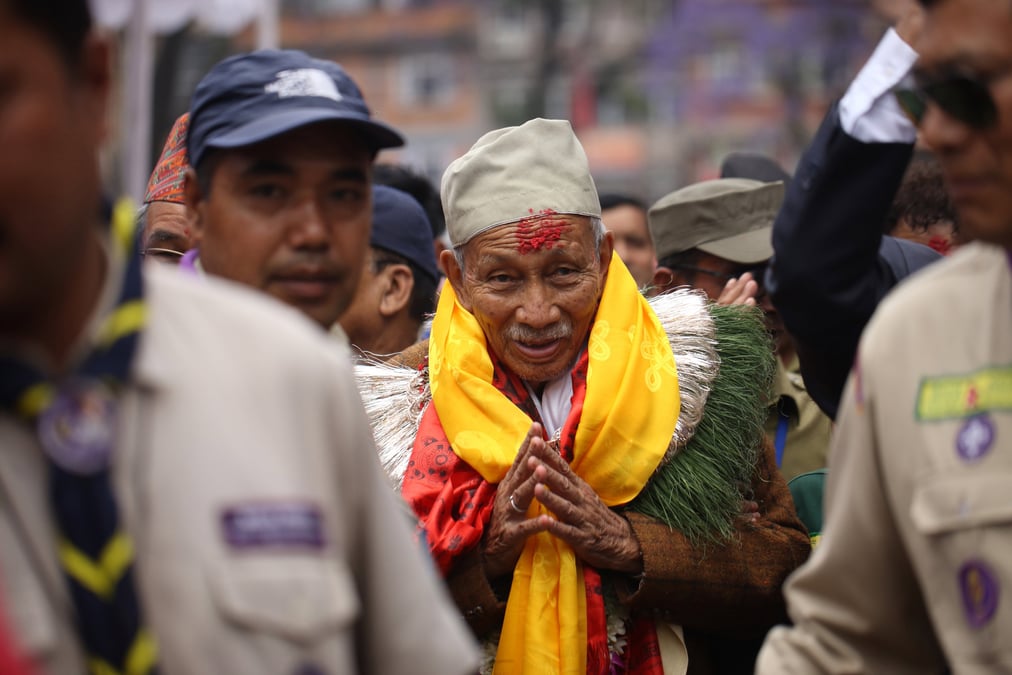
The moment someone says “Jojolappa”, an image springs to mind of a person grabbing another by their arm. It is a very visual term.
The Newa greeting was popularised by Pabitra Bir Singh Kansakar and colleagues in 1996, on Good Night FM.
Nepal Bhasa is a tonal language because of which a slight nasal ring to a word often tends to change its entire meaning. If “jo” becomes “jon”, it would mean hold or grab. “Lappa” means arm. So the word can literally mean, “grab the arm” if one says Jonjonlappa.
And so whenever someone says “Jojolappa”, I am always tempted to reply politely: Please do not grab my arm.
The first time I heard this term was at a poetry reading session in a garden in Kamaladi in 2000. Poet Pushpa Ratna Tuladhar (incidentally, my grandfather’s namesake) spoke about the induction of jojolappa into spoken Newa and mentioned the FM radio use.
The 1990 democracy movement brought in sweeping changes, also introducing indigenous language content on radio, and Nepal’s media landscape discovered diversity.
Kansakar used to run the Newa language program on Good Night FM and started out greeting listeners with Namaste. The Newa greeting Taremaam, but it didn’t seem appropriate for use at night.
“My friends from Bhaktapur said they had been using the greeting Jojolappa,” recalls Kansakar. “But we didn’t know if it was a real word or if they said it in jest.”
In Kathmandu, people were not used to the word. When Kansakar brought the idea to his colleagues at the radio, they first rejected it and said it was not a real word. Eventually, they were convinced.
“We thought it was a good idea and we didn’t really ask anyone outside and we started using it,” adds Kansakar. “One time late Satya Mohan Joshi came to our office and he told us that the accurate pronunciation of the word was “Jojolappe” and not “Jojolappa”.
But, the pragmatist that the scholar was, he said that since we had already established the word and popularised it, they could stick to it.
Laab Ratna Tuladhar, a writer, also reached out to Kasaâ confirming the correct pronunciation as Jojolappe. But from phone-in programs, Jojolappa had already spilled out into Newa public events.
According to research by writer Ojesh Singh, A Dictionary of Classical Newari, compiled from Manuscript Sources by the Nepal Bhasa Dictionary Committee, has some clues on the term.
In the dictionary, javarapava/jararape is described as the act of joining hands, followed by the description: tava purusa, samtosa yaya, hatha javarapa (Great men are to be satisfied by salutation). There’s clearly Sanskrit influence says Kansakar.
Another example from the dictionary: he paramesvara, hatha javalape translates as: Oh God, I bow down and greet you with folded hands. Note words like hatha, paramesvara, are Sanskrit terms.
Kansakar says the easiest way to understand the term is to understand it as “Binti yana” or “I request you”.
Some colloquial explanations for “jojolappa” describe it as the act of joining of arms. I recall Tuladhar and his friends discussing how the word sounded like the summation for the image of a pair of hands-- cha jo lha pa. Lha comes from Hastha in Sanskrit, just as bhwea (feast) comes from bhojan.
Tuladhar and his friends at the time, pointed out the awkwardness of the term and commented on how foreign and contrived it sounded. It is the universal response to words that are coined to introduced from another language.
That wasn’t going to be the first time I would hear such remarks about the term. Even today when the word is flung among Newa people as a greeting in informal settings, they either approach the term with extra care or giggle as they say it aloud.
Traditionally, in formal and informal settings, Newa people bow their heads down to greet their elders: Bhagya ti/Anya ti. For others, if it is early in the day they might put up the right hand, palm facing outward and shout Taremam, a term dedicated to the goddess Tara and so mostly used in the Buddhist Kathmandu hoods.
Some use Bhagwan Sarana, in the refuge of gods. People also quietly ask: Mha phu la? Are you well? In some formal settings, people are known to say: Maan tayka jhala. Your arrival gladdens my heart. Then there even is Jay Ma Bhaye, long live the mother tongue.
At the time Kansakar and friends introduced the term, a binding greeting for radio use seemed necessary and since Newa does not have a singular word for such use, something equivalent to Namaste had to be coined.
Even if it meant adopting a term rooted in the classical, instead of everyday Newa. Jojolappa represented gain, given the history of suppression of the Newa language during the Rana and Shah regimes when the language was banned and Newa writers and activists disbanded and thrown into cells. It was during those years that Jay Ma became popularised as a greeting.
Jay Ma Bhaaye was the greeting my father says he and his friends used in the 70s, when they went from dabu to dabu in the three cities, performing Newa songs.
During a meeting with the great Newa poet Durgalal Shrestha last year, I had mentioned to him how Jojolappa has always felt like a very masculine term to me. I asked him what he thought about the term and he said, “I don’t know, this wasn’t a term we used to use in the past.”
After years of wondering if I should or should not jojolappa, I finally understand the idea of the term. Still, if I had to invent a greeting, I would like for it to say something vibrant, like the Tagalog Mabuhay, long live! Something life-giving. Or, something soft and kind. For now, I will just bow.
Suburban Tales is a monthly column in Nepali Times based on real people in Pratibha’s life.