
Nepal has two months to go for polls, India’s general elections are six months away, and bizarre things are happening as campaigning picks up.
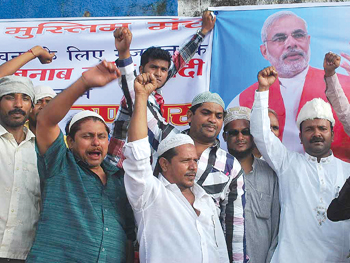
But even by subcontinental standards, nothing can quite surpass the spectacle of India’s Bharatiya Janata Party’s (BJP) bringing to its rallies people sporting skullcaps and burqas and shepherding them into a reserved enclosure as happened in Jaipur last week at a BJP rally where its prime ministerial candidate Narendra Modi was star speaker. Other state units of the BJP have promptly taken their cue from Jaipur.
For whom is the BJP creating the sight of an enclosure brimming with skullcaps and burqas? Conventional wisdom tells us: Muslims, obviously. But why ask Muslims to sport these markers of identity when they are already flocking to the rally? Well, it’s because the BJP harps on the presence of Muslims as evidence that the community has rethought its opposition to Modi.
What the BJP hasn’t explained is why. Is it because its saffron brigade has made some kind of reconciliation with Muslims? Or is it that the possibility of Modi becoming prime minister of India has filled Muslims with such dread that they are trying to appease him through participation in his rallies?
BJP leaders will tell you that Muslims and other social groups are enamoured of Modi’s governance model and the supposedly dazzling development he has ushered in Gujarat. Since the model of development will soon be replicated countrywide and Muslims will benefit, they have decided to forget the grisly pogrom in Gujarat in 2002. But this explanation is ahistorical, for it wasn’t the Gujarat riots which alienated the Muslims from the BJP.
Indeed, the relationship between the BJP and Muslims has been fraught for decades, dating back to 1925, when the Rashtriya Swayamsevak Sangh (RSS) - which is to the saffron brigade what Sonia Gandhi is to the Congress - was established in Pune. The RSS wants to create a Hindu Rashtra in which those whose holy land and motherland are not the same, are to live as second-class citizens. This idea influenced the RSS to perceive Muslims as foreigners and as ‘other’. This is why the Sangh’s pet political projects - the Ram Janmabhumi movement, the anti-cow slaughter campaign, the demand for a Uniform Civil Code - have all been directed against Muslims. This hostility underlies several instances of Hindu-Muslim violence, a conclusion several commissions probing the riots have reached in the past.