
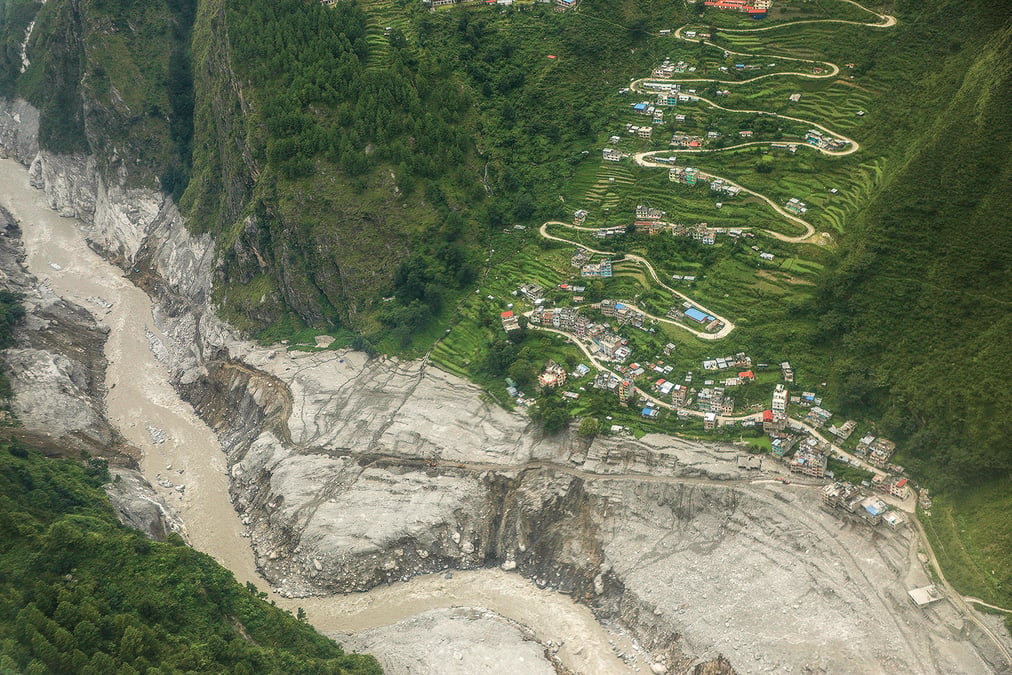
Total death toll of the Trishuli Valley flood is likely to surpass 7,000. But only 1,453 bodies have been recovered with less than 10% of them identified.
This disproportionate figure in recovery and identification more than a month after the 26 August catastrophe is yet another measure of the enormity of this disaster.
For families of the missing this has been the most grueling – and sometimes gruesome – task. They have had to pore through graphic photographs of hundreds of corpses at hospital morgues, provide DNA samples and wait for news. And then wait some more.
This lack of closure has prolonged the trauma of loss for many families in Nepal and abroad. Forensic experts say that given Nepal’s resources, and despite outside help, it may take months to identify remains in morgues and temporary mass burial sites deep in the forests of Chitwan, Gokarna, Pokhara and Nawalparasi.
“We have to speed it up as much as we can but there are issues of human resources and technical expertise. What the government could have done was set up a Disaster Victim Identification Team to better manage the whole thing,” adds forensic expert Harihar Wasti who worked to exhume bodies during the Maoist conflict.
He adds: “It will take another six months or even a year for all the bodies and body parts to be identified. In the meantime, we have to make sure our social protection mechanisms for the survivors are in place and working.”
Most families have given up hope of ever finding the remains of their loved ones and held symbolic funerals. Others have questioned the delay in DNA identification being done in just two government facilities: the Central Forensic Science Laboratory and the National Forensic Science Laboratory. India, China, Japan, South Korea, Japan, Singapore, Australia and the United States whose nationals are among the 650 people from 38 countries still missing, have also sent forensic experts and equipment.
Till this week, only 112 bodies had been identified and handed over to relatives. Family members have submitted 2,060 DNA samples, and 1,329 tissue samples have been collected from recovered bodies. The labs are racing against time to identify the remaining 1,341 recovered bodies.
“The number of bodies or parts recovered is not a large processing number, but there are several factors that might be contributing to the backlog,” explains Dibesh Karmacharya of the Centre for Molecular Dynamics Nepal. “First, how many bodies or parts were recovered, from where and in what condition. Next, is the DNA database with the samples of next of kin.
Karmacharya is surprised that only 10% of the recovered bodies have been identified so far despite international support: “It is quite low. Private facilities like ours have the technical know-how, and capacity to help and we cannot understand why the government is seeking more expensive and time-consuming international partners when there is domestic expertise readily available.”
Other experts say that fingerprint examination of bodies recovered after the first few days and matched with official documents could have sped up ID. Extracting DNA profiles from decomposed bodies or fragmented remains require complex processing of bone and teeth, taking significantly longer than standard blood or soft-tissue extraction.
There are legal ramifications to the delay. Lack of a death certificate means family members could be denied relief, compensation and insurance. This may especially affect children who lost both parents in the flood but cannot be declared orphaned and get access limited state benefits. Their parents are technically ‘missing’, not dead.
Section 40 of Nepal’s National Civil Code 2017 stipulates that under ‘normal circumstances’ a person cannot be declared dead until they have been missing for 12 years. But the law in its current form already has a provision allowing for judicial declaration of death without a wait period in times of disasters. Which is why the delay in issuing death certificates is so puzzling.
“Under Section 40(4) of the Civil Code, if a person disappears in a natural disaster, a relative can immediately file for a Judicial Declaration of Death at the district court,” explains advocate Indu Tuladhar. “We already have necessary legal provisions to address the current crisis. What we should focus on is streamlining the process for families, maybe by adding more officials, and deploying the apex court in Rasuwa, Dhading and Nuwakot.”
She adds: “The bigger legal issue could be issuing citizenships to children whose parents and relatives have all perished. If we don’t document them all now, a few years down the line when we have all forgotten this disaster, the children will face a bigger legal battle.”
The Home Ministry has drafted an amendment to the statute to streamline death registration and relief for relatives who have lost kin in disasters. For the relatives of the missing and those waiting for identification of bodies, that cannot come soon enough.