
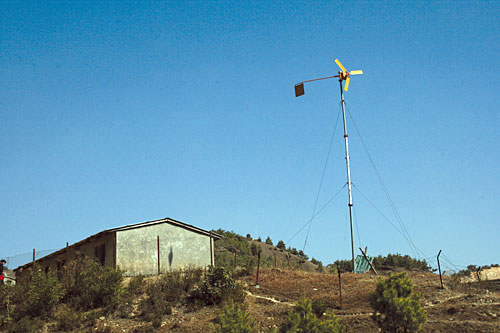
 PUSHKAR MANANDHAR HARNESSING NATURE: A turbine built by Practical Action in Pakhel, Makwanpur. |
A crippling power shortage that is here to stay, ease of installation and affordability are making experts take a fresh look at windpower in Nepal.
There was optimism in abundance at a recent National Workshop on Wind Energy, organised by the Alternative
Energy Promotion Centre (AEPC) and Tribhuvan University.
"This is the first time I have seen so many people keen on windpower," commented Rakesh Sinha, a researcher at a windpower company.
A mix of public and private stakeholders were invited, after a nine-year lull, to exchange experiences and review the draft national wind policy, recently prepared by the National Wind Task Force (NWTF). The paper intends to draw foreign investment for utility-scale wind turbines, particularly through the construction of a model project generating more than 500KW. It also means to protect the interests of local manufacturers of small wind turbines no larger than 10KW.
"We should hand over the draft policy to the ministry in the next three months. Parliament should pass it within six months, after which we hope to pilot a commercial wind farm in a year," says NWTF member Manoj Kumar Mishra.
Government, private sector and non-governmental organisations have invested intermittently in windpower over the past three decades. In 1989, two wind generators of 10KW capacity each were built in Kagbeni, Mustang, but both were blown down by high winds. This deterred further interest in windpower.
With power cuts, windpower has gradually regained credibility as a viable, quick, and possibly cheap solution. "In the past when one brought up wind energy, government officials would respond with hawa ma kura garne (talking in the wind). This is no longer the case," says Govind Pokharel, formerly of AEPC. Windpower is quick to install and offsets carbon emissions by reducing deforestation and consumption of imported petroleum-based products.