
 RUBEENA MAHATO |
The monsoon rains are not yet on the horizon, but the mini-epidemic of diarrhoea that has afflicted Maoist supporters in the Kathmandu Valley should remind us of the continuing woes of western Nepal. Baitadi has already seen seven deaths due to diarrhoea, with outbreaks in district headquarters Dasrathchand as well.
According to the District Health Office, there was a 56.7 per cent increase in cases of diarrhoeal diseases between February and March. Mohan Singh Thagunna, Public Health Inspector in Baitadi, says, "Deaths have been reported from Sigas, Gajari, Thalakanda and Shivling VDCs but diarrhoea cases have been observed throughout the district mostly among women, Dalits and children."
Since last summer's outbreak, which left 11 dead in Baitadi, there have been no follow-up programs by the government in the affected areas. Does this mean the epidemic that claimed the lives of 282 (WHO, August 2009) in west Nepal hasn't changed government strategy at all? Not entirely. This year, whenever cases of fatalities have been reported, government Rapid Response Teams have been dispatched with Oral Rehydration Solution (ORS), soap and medicine. No doubt this is what the government should be doing at the moment but the crux of the problem lies elsewhere.
When prevention has been shown to be work wonders, why wait until the situation gets so bad that the best one can hope for is damage control? Simple measures such as teaching people about hand washing, water purification, safe excreta disposal and ORS use are in order. Rather than simply reacting when disaster strikes, the government should work year-round to provide access to safe drinking water and promote good hygiene.
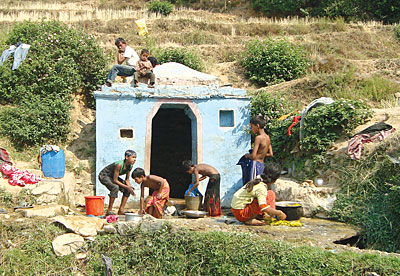
"Drinking water coverage in the district is almost 90 per cent," says Devnath Yadav, Acting Divisional Engineer of the Drinking Water and Sanitation Division Office, Baitadi. But in reality, potable water is so scarce here most people drink water from unprotected wells that are potentially highly contaminated. One such source is the well at Dasrathchand-1 where Oxfam carried out a water quality test recently. Results showed 29 Coliform per 100 ml, while WHO guidelines determine that no such bacteria should be detected in a 100 ml sample.