
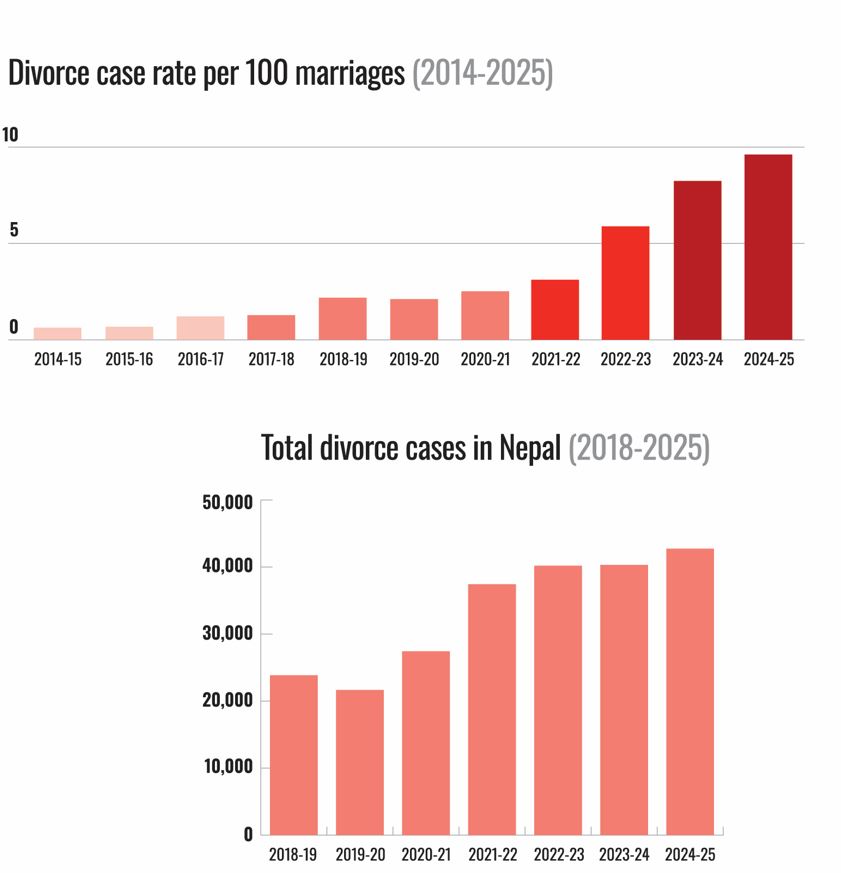
The divorce cases rate in Nepal has doubled in the past five years, with nearly one in every ten marriages ending in separation.
This does not include those who have separated unofficially, and among registered divorces are those who had wed before they reached the legal marriageable age of 20, as well as senior couples over 75.
Court registries show that last year alone, 42,739 couples all over Nepal were fighting legal battles to terminate their marriages. Five years ago, that figure was only 21,649. Since divorce involves two people, more than 85 thousand families were involved in courts.
Besides this dramatic increase over time, divorce prevalence also shows a marked spatial distribution with the districts of central Nepal having the highest rates.
In 2023-2024, Myagdi had the highest divorce rate of 75 per 10,000 persons, followed by Tanahu, Kaski, Chitwan, Lamjung and the Rukumkots (map).
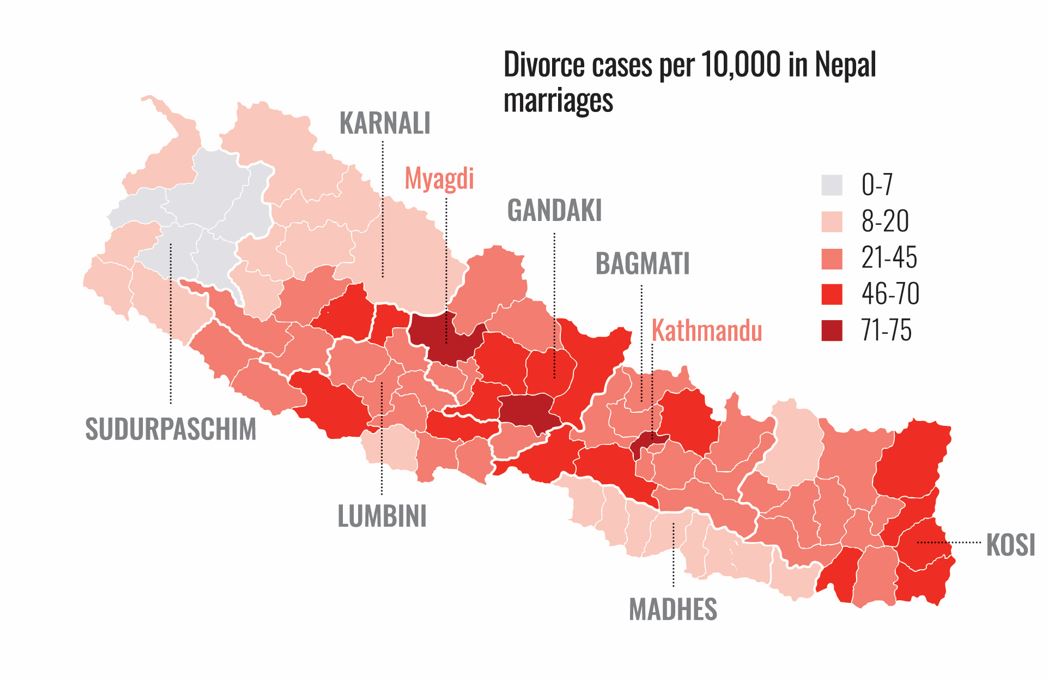
Kathmandu had the second-highest divorce rate in the country, with separations also common in Panchthar and Ilam in the east.
There was a 19-fold increase in divorce cases between 1998-2000 in district courts in Jhapa, Sunsari, Parsa, Rupendehi, Palpa, Kaski and Banke, and this has only gone up since.
Divorce rates have been rising dramatically every year, except in 2019-2020 because of the Covid lockdown. The sharp increase in 2022 could also be due to court backlogs. The number of divorce cases has overtaken all other categories of court cases since 2021.
According to the latest Annual Report of the Department of National ID and Civil Registration (DNIDCR) of the 289,000 marriages registered nationwide in 2023-24, there were 24,000 divorces. The divorce rate per 100 marriages went up from 0.6 in 2014 to 9.58 in 2025 (graphs). The number of new cases has also nearly doubled since 2019.
The report also shows that 341 young women and 50 male adolescents divorced between 2019-2023 — indicating the persistent prevalence of child marriage. In that period, 156,000 boys (9.8% of total males who registered their marriages) and 362,000 girls (22.7% of females) were under 20, the legal marriage age.
More than 800 senior citizens went to the courts to terminate their marriages, and among them 39 males and three females were above 75 years, which is even higher than Nepal’s life expectancy.
In general, women tend to get divorced earlier than their male counterparts. The DNIDCR report notes that the highest number of female divorcees (nearly 30%) were in the 25-29 age group. Highest number of male divorcees (26%) were aged 30-34.
The DNIDCR report also shows that 13,000 couples who got officially divorced between 2019-2023 did not have any children. There were nearly 43,000 children of divorced parents in that time. In 2023, there were 21,500 Nepali children of divorcees.
COURT CASES
Divorces lead to the breakdown of families, and often there are disputes over alimony and inheritance. In fact, the number of cases in the courts involving inheritance has doubled in the past ten years. Inheritance and divorce disputes have always topped the list of cases in the courts.
The DNIDCR annual report tries to get to the bottom of the higher legal separation rates, and blames changing societal mores, demographic shifts, long separation of couples due to overseas migration, and increase in literacy rates. Cultural factors may also affect abnormally high divorce rates in certain parts of Nepal.
Forty of Nepal’s 77 districts have divorce case rates higher than the national average. Tanahu-Kaski-Myagdi have 60-75 divorces per 10,000 marriages.
Districts with the lowest divorce rates also tend to be the ones with the lowest Human Development Index (HDI), and those higher up in development rankings like Kathmandu, Chitwan, Ilam have generally higher rates of divorce.
Among exceptions to this rule are Lalitpur and Bhaktapur. The two districts are the second and the fourth highest HDI rankings in Nepal, but are 22nd and 47th in the divorce case rates. Solukhumbu and Manang also have comparatively low divorce rates, even though they score relatively high in HDI.
Doti has the lowest divorce case rate (3.03 per 10,000 persons) — which is four per cent of Myagdi. Achham, Baitadi, Bajhang, Bajura, Mugu and Kalikot in the mountains of western Nepal and Rautahat, Mahottari and Saptari in the eastern Tarai also have low divorce rates. Both regions of Nepal have entrenched patriarchy and caste system.
The divorce case rate of Saptari is much lower than its neighbours to the east (Sunsari) and north (Udaypur). Likewise, Tanahu with far lower HDI compared to Kathmandu is only one step behind Kathmandu in divorce-case rate.
The two Rukums, Rolpa, Sindhupalchok and Gorkha have much higher divorce case rates compared to their HDI.
Among the cluster of districts with low divorce rates are Dolpo, Mugu, Humla, Bajhang, Darchula, Baitadi, Dadeldhura, Doti, Achham, Bajura and Kalikot which have the lowest HDI and literacy rates, but show less than 14 divorce cases per 10,000 persons.