
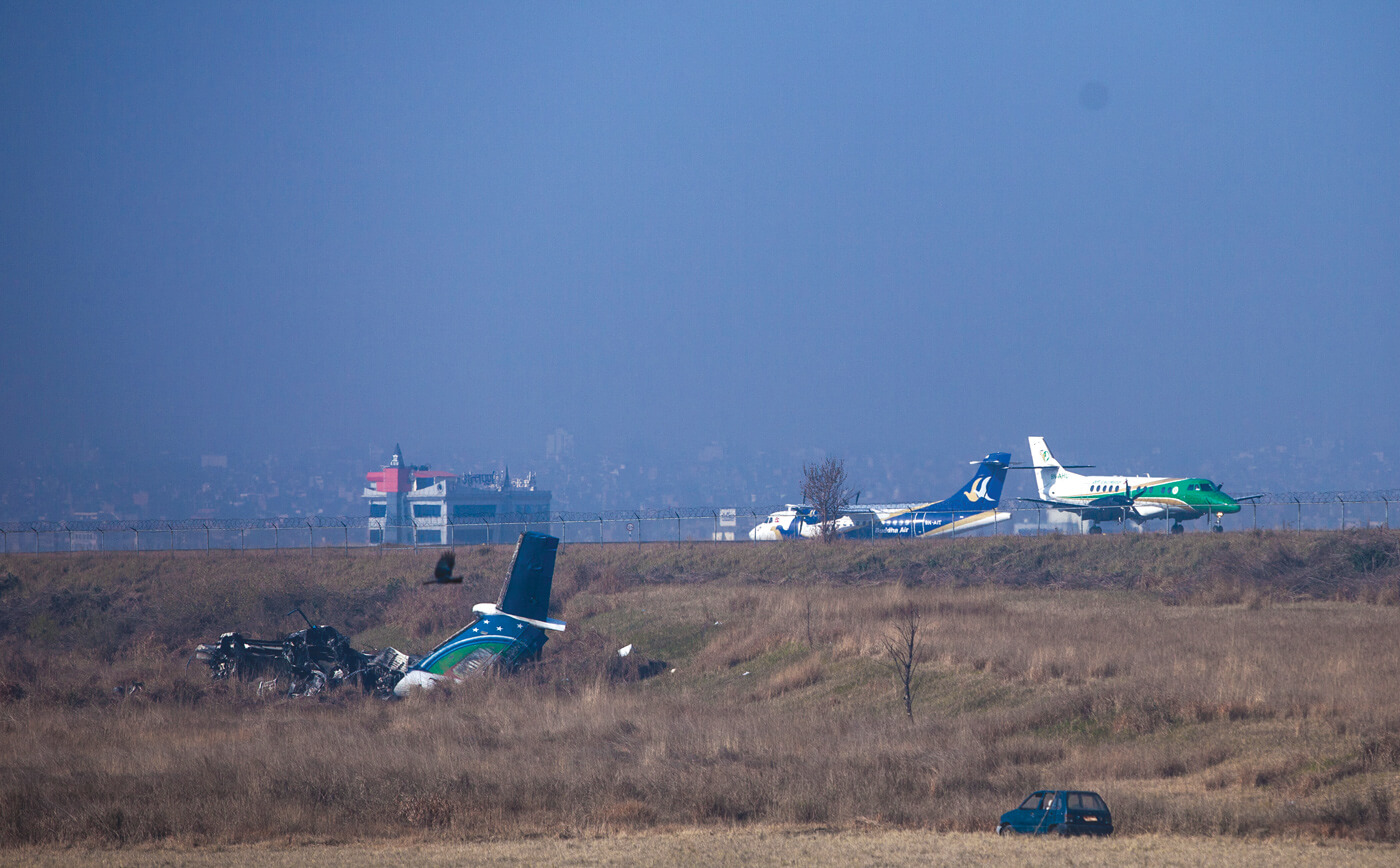
One year after the horrific crash in Kathmandu of US-Bangla Airlines Flight BS211, new evidence confirms the captain was mentally unstable and unfit to fly. But this is of little consolation to the relatives of the 51 who perished in a tragedy that was easily preventable if safety standards had been met.
Read also:
20 by 02, Kanak Mani Dixit
Individual tragedies, and a national loss, Monika Deupala
Capt Abid Sultan was abusive, erratic and incoherent even before the plane took off from Dhaka on a flight to Kathmandu on 12 March, 2018 with 67 passengers and 4 crew. A full transcript of the Cockpit Voice Recorder (CVR) obtained by Nepali Times shows that the mental state of the Captain was much worse than first indicated in an ATC (Air Traffic Control) tape, and should have set off alarm bells even before the plane took off.
On approach to Kathmandu the Bombardier Q400 turboprop twisted and turned over the airport before crashing and bursting into flames off the runway. The government’s Accident Investigation Commission released its report in January, concluding that Capt Sultan was ‘stressed and emotionally disturbed’ about another female pilot in his company. Actually he was more than that, he was excessively obsessed with her.
The transcript (below) begins with conversation between US-Bangla Operations while still on ground in Dhaka. Sultan is volatile and explodes into foul language for no reason at all. First Officer (FO) Prithula Rashid, on her first route proving flight to Kathmandu must have already been terrified by the outbursts. But crew gradient seems to prevent her from reacting to her senior instructor.
Capt Sultan talks nonstop during the flight with angry monologues about another young female pilot whom he had trained, Farhat Lamia Khaled. He is obsessed about her alleged comments doubting his competency to be an instructor.
Read also: Ashna isn't coming home, Sikuma Rai
US-Bangla crash Kathmandu airport CCTV footage. Video: shailendra @theshailen (Twitter).
Sultan’s hostility towards Lamia also seems to be personal – in sentences peppered with bilingual obscenities he casts aspersions on her morality and disparages her appearance. Halfway through the flight, citing rumours about their involvement Capt Sultan breaks down and starts weeping openly, telling his copilot that he was quitting the company because of Lamia.
As they start their descent, Capt Sultan temporarily regains his composure and in a professional and calm voice resumes his role of an instructor pilot, preparing the trainee pilot for approach and go-around procedures for Kathmandu. Throughout the transcript he alternates between being polite and kind to her one moment, even complimenting her airmanship, and then reverting to abuse-laden tirades the next.
The plane is cleared for approach, and Capt Sultan confirms landing gears are down, when they are not. In the course of the next few minutes he asks FO Rashid five times if she has completed the Pre-landing Checklist even though she confirms it every time. All the while, the landing gear error audio warning is sounding in the background.
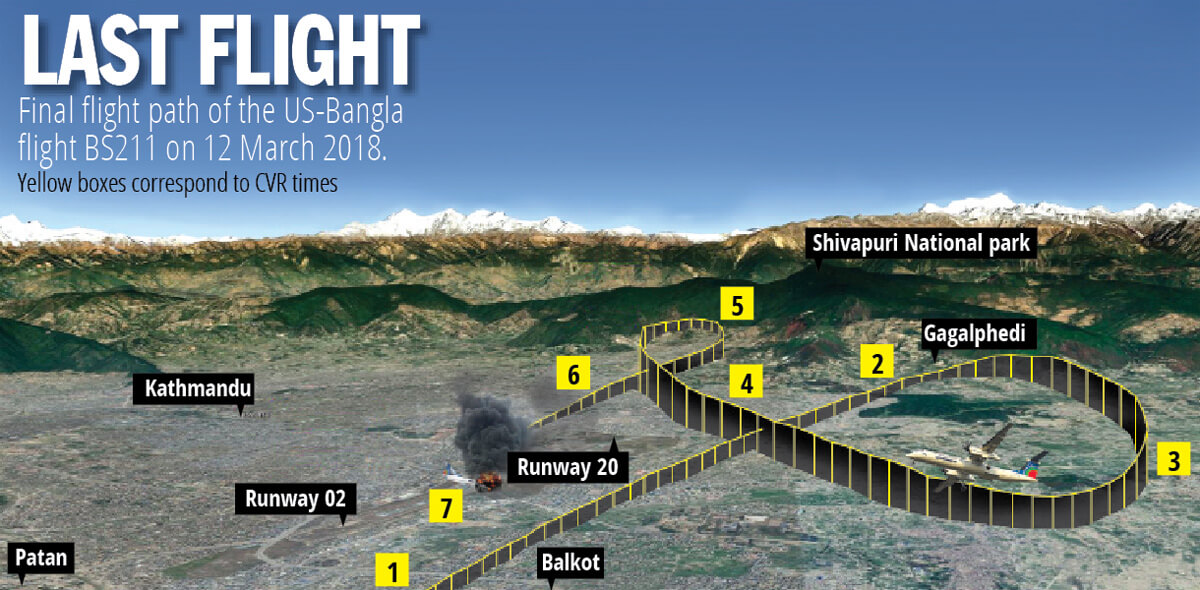
Kathmandu Radar hands the flight to tower frequency and it is cleared for the standard VOR-DME approach. But when the plane should be on finals, it is actually 3km to the east of the approach path at rooftop level.
Margie Donahue is an American educator living in Balkot, and remembers seeing the plane with a blue tail flying very low and fast over her house. “I thought it would hit our roof and I waited for a big bang because I was sure it was going to crash,” she told Nepali Times.
In the ATC tape, a female controller then comes on the radio to alert the flight crew: “BanglaStar211, you were given landing clearance to runway 02 … You are going towards runway 20.” Seeing the plane so far to the east, the controller appears to have thought the flight was entering downwind to make a circling approach to Runway 20 from the north side. After confirming the pilot is visual, a male controller takes over to instruct the plane not to land yet because of another traffic on finals.
The CVR transcript indicates Capt Sultan mistakenly thinks the VOR beacon is ahead of him when the plane is already flying northeast of the airfield straight towards Shivapuri mountain. There are miscues, misinterpreted intentions, language problems and lack of assertiveness on the part of controllers.
After reviewing the CVR, a shocked Airbus 320 commander told us Kathmandu Radar should have first warned the plane he was deviating from the approach path, and failing that immediately ordered the plane to carry out a standard missed approach procedure when it overshot the runway. Instead, the Tower let the disoriented pilot blunder on.
Meanwhile in the cockpit, the EGPWS (Enhanced Ground Proximity Warning System) is going off loudly and continuously as the plane approaches Shivapuri. To avoid hitting the slope, Capt Sultan puts the plane into a steep turning climb (see map, right). Probably sensing that his co-pilot is nervous, he reassures her, admitting calmly that he has made a mistake, adding, “It happens, isn’t it?”
At Gagalphedi village at the base of Shivapuri, locals hurriedly gathered to watch the Q400 descend dangerously low, and at the last moment pull out of the dive with both its landing lights on, and main gears down. A mobile video posted on YouTube is a key piece of evidence showing how close the plane already was to a crash. (Video clip above)
Two pilots on domestic flights are then heard on the ATC tape warning the tower in Nepali that the Bangladesh plane seemed lost: “He looks disoriented, doesn’t know where he is going. Vector him out of here.”
The plane makes an orbit at base leg northwest of the field at 6,500ft while both pilots look out of the runway. When he sees the airfield, Capt Sultan descends steeply in an abnormal and dangerous approach, banking steeply left, and missing the hangar roof by only 45ft.
In the Tower, shocked air traffic controllers duck when they see the plane come straight at them. The Q400 then flies over the international apron narrowly missing a fully-loaded 777, and several 737s and 320s. The plane is at a 15o angle to the runway heading when its right landing gear hits the tarmac hard before veering off, and down the slope.
Driving to the airport on the Ring Road, frequent flier Arnico Panday saw what he thought was an ATR-72 make a tight turn over the hangar, nearly hit the tower and disappear. “Moments later I saw the plume of black smoke,” Panday recalls.
Most of the passengers on the left side of the plane were either killed by the impact or the ensuing fire. Many who survived were sitting on the right side, or towards the front.
The Investigation Committee Report concludes: ‘The PIC (Pilot in Command) was under stress and emotionally disturbed as he felt that the female colleague of the company questioned his reputation as a good instructor. This together with the failure on the part of both the crew to follow the standard operating procedure at the critical stage of the flight contributed to loss of situational awareness to appreciate the deviation of the aircraft from its intended radial that disabled them sighting the runway.’
All audio warnings on the flight deck are going off simultaneously in the last few seconds of the CVR: “Terrain, Terrain”, “Sink Rate, Pull Up, Pull Up”, “Bank Angle, Bank Angle”.
The Radio Altimeter warning calls “100 Minimums”, then “50”. The last words heard are of FO Rashid, sounding alarmed: “Sir, Sir!”
With reporting by Sharad Ojha
"Sir! Sir!"
The Accident Investigation Commission set up by the Ministry of Tourism and Civil Aviation in January presented its report containing the graphic transcript of translated conversation picked up by the Cockpit Voice Recorder on US- Bangla BS211. Till now, clues about the state of mind of the pilot in command had come from the Air Traffic Control tape posted on the Internet on the day of the crash. This transcript shows that Captain Abid Sultan’s state of mind was much more unstable than first thought. Excerpts:
Read also: US-Bangla plane crashes at TIA
CODES
Internal cockpit conversation, with transmissions to Ground in bold
Time in UTC
Numbers in bold correspond to yellow boxes in map of the flight path
["SQUARE BRACKETS"] are audio cockpit warnings FO: Flight Officer OPS: US-Bangla Operations
PIC: Pilot in Command
Bangla: Conversation translated from Bangla
KTM: Kathmandu
ADC: Air Defence Clearance
FIC: Flight Information Centre
Romeo: Waypoint southeast of Kathmandu
Guras: Waypoint 12 miles south of Kathmandu
VFR: Visual Flight Rules
EGPWS: Enhanced Ground Proximity Warning System
DME: Distance Measuring Equipment (miles from beacon)
VOR: Visual Omni-directional Range beacon
ROD: Rate of Descent
FO: 0636:20.2 Dhaka Ground BS211 good afternoon
Dhaka Ground: 0636:20.2 BS211 good afternoon, go head ma'm
FO: 0636:34.8 BS211 standing at 28 South flight for KTM FL 240
PIC: 0642:24.0 Do you have the ADC number? (Bangla) FO: 0642:25.9 No Sir, I have one number 2177
PIC: 0642:25.9 Operations, BS211, how long will you take to respond, I want the ADC and FIC. (Angry tone)
OPS: 0643:31.5 KTM FIC for 211 is 1171 ADC KX 848 and for 212 FIC PIC: 0643:39.7 I don’t want f--k 212, I want 211 (Very angry) … I don’t want to f--k you, read you, again? Keep your f---ing mouth shut.
PIC: 0650:10.5 Got the clearance? FO: 0650:09.1 Yes sir, line up is due.
PIC: 0650:16.0 Don’t be scared, I am going to stay for another 3 months, I am going to f--k these people right and left.
Dhaka Tower: 0650:25.7 BS211 clear line up runway 14 FO: 0650:30.4 Clear line up, clear line up runway 14, BS211
PIC: 0651:03.5 Bismillah, have we done the takeoff checklist? (Bangla)
FO: 0651:40.5 80 kts, power set, V1 rotate, positive rate
PIC: 0652:32.5 Look out for birds PIC: 0652:44.9 Autopilot engaged, 1,000, turning right. Perform the flow check (Bangla)
Dhaka Tower: 0652:49.9 BS211 airborne 52, call turning right FO: 0652:46.4 We are turning right BS211 Dhaka Tower: 0652:57.5 Roger re-cleared to 240, call passing 4,000 FO: 0652:57.5 Recleared to 240, we’ll call out of 4,000