As the Maoist conflict intensified, a demoralised Nepal Police fought with .303 rifles. It launched ‘Romeo’ and ‘Kilo Sierra 2’ Operations to hunt Maoists, but killed and tortured a whole lot of civilians whose families then joined the guerrillas. (‘Kilo Sierra’ seemed to be accurately named because it was all about ‘killing’.)
Girija Prasad Koirala of the Nepali Congress (NC) was prime minister, trying to keep both his party and the country from splintering. The opposition UML was shutting down Kathmandu every other week, forcing people off the streets by terrorising them with arson on vehicles that defied strikes.
Koirala himself was under pressure to resign after the CIAA implicated his party’s top figures of taking kickbacks in the lease of a Boeing 767 from Austria’s Lauda Air. He also wanted to form a separate Armed Police Force (APF) to fight the Maoists with heavier weapons.
A worried King Birendra watched warily as feckless, corrupt politicians squabbled and the Maoist violence spread. As constitutional monarch, he was under pressure from hardliners in his family to be more decisive, and take control of the country.
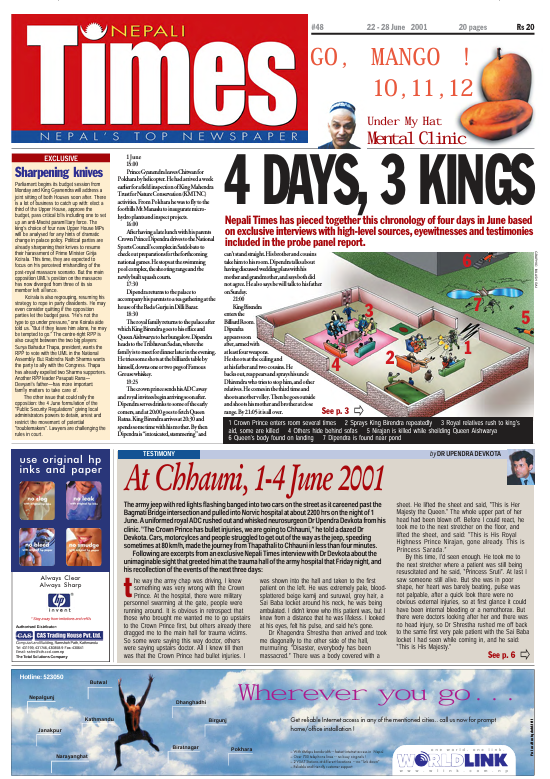
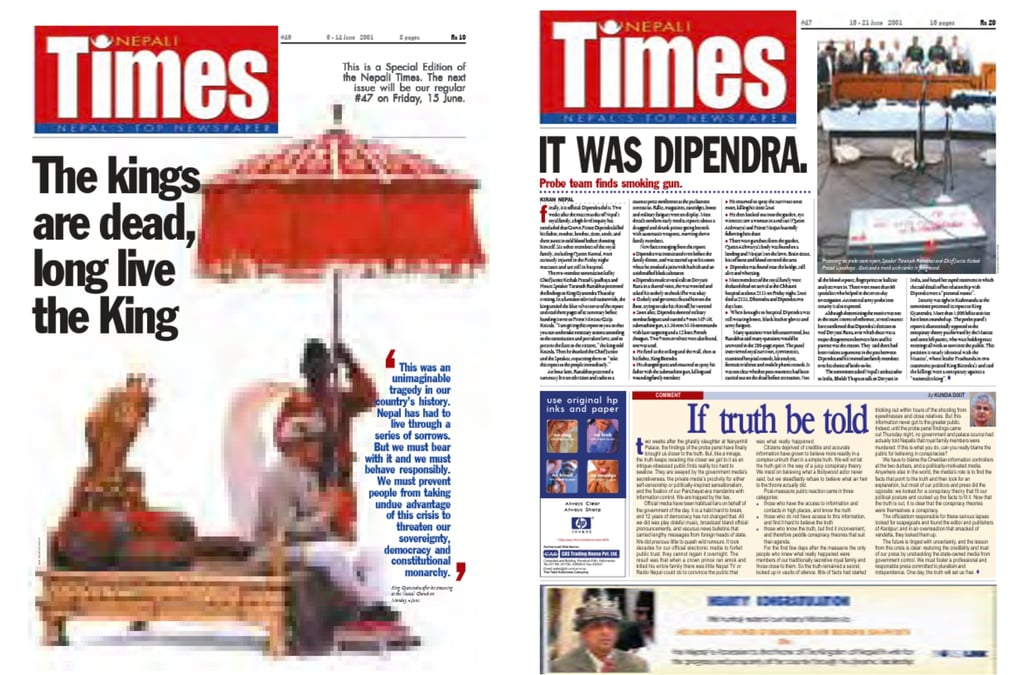
On the morning of Friday 1 June 2001, the Editorial in Nepali Times was titled ‘Long Live the King’. On page 14 was a translation of a piece from Naya Sadak newspaper by Kishore Nepal titled ‘A Suitable Prince’ about Crown Prince Dipendra’s marriage prospects. It read: ‘Crown Prince Dipendra turns 31 on 27 June. It is high time he got married.’