
The UML swept the local elections in mid-2017, and as a member of the Left Alliance went on to win a near-landslide in parliamentary and provincial elections last month. Voters showed they were attracted by the Alliance’s catchy slogan of ‘prosperity with stability’.
We can’t comment about stability because the dramatis personae of Nepal’s never-ending transition are the same. In the month after elections, they have shown no real change in their modus operandi.
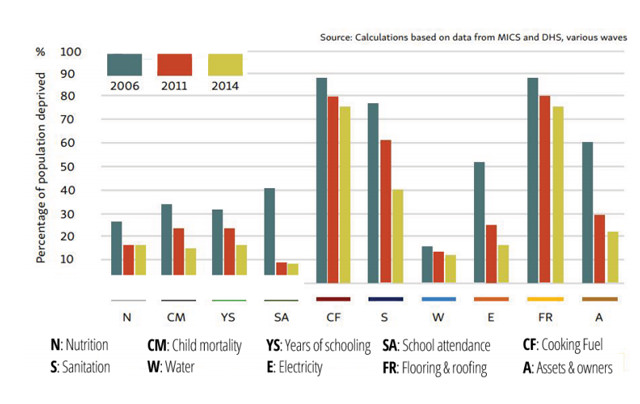
But we can hold out some hope on the prosperity front. Well, maybe not wealth creation as such, but certainly in reducing overall poverty. As the result of the latest wave of the Multidimensional Poverty Index (MPI) survey conducted by the National Planning Commission in 2014 shows, Nepal has seen the incidence and intensity of poverty fall by more than half – from 59.3% in 2006 to 28.6% in 2014.
The figure of 28.6% is slightly higher than the national rate for income poverty of 23.8%. The reason for this is that MPI takes into account a diverse range of parameters to measure deprivation: it goes beyond just income figures to factor in nutrition, education, child and maternal mortality, household energy use, along with roofing and flooring of a house, sanitation and water supply.
What is surprising is not that poverty has decreased dramatically over the last decade, but that it has decreased despite chronic instability and poor governance under successive regimes since the end of the conflict in 2006. One of the reasons is the $6.1 billion that Nepal receives annually from overseas workers, although the figure is probably much higher because it is only an estimate based on official bank-to-bank transfers and does not include money the 2.5 million Nepalis working in India bring home.