
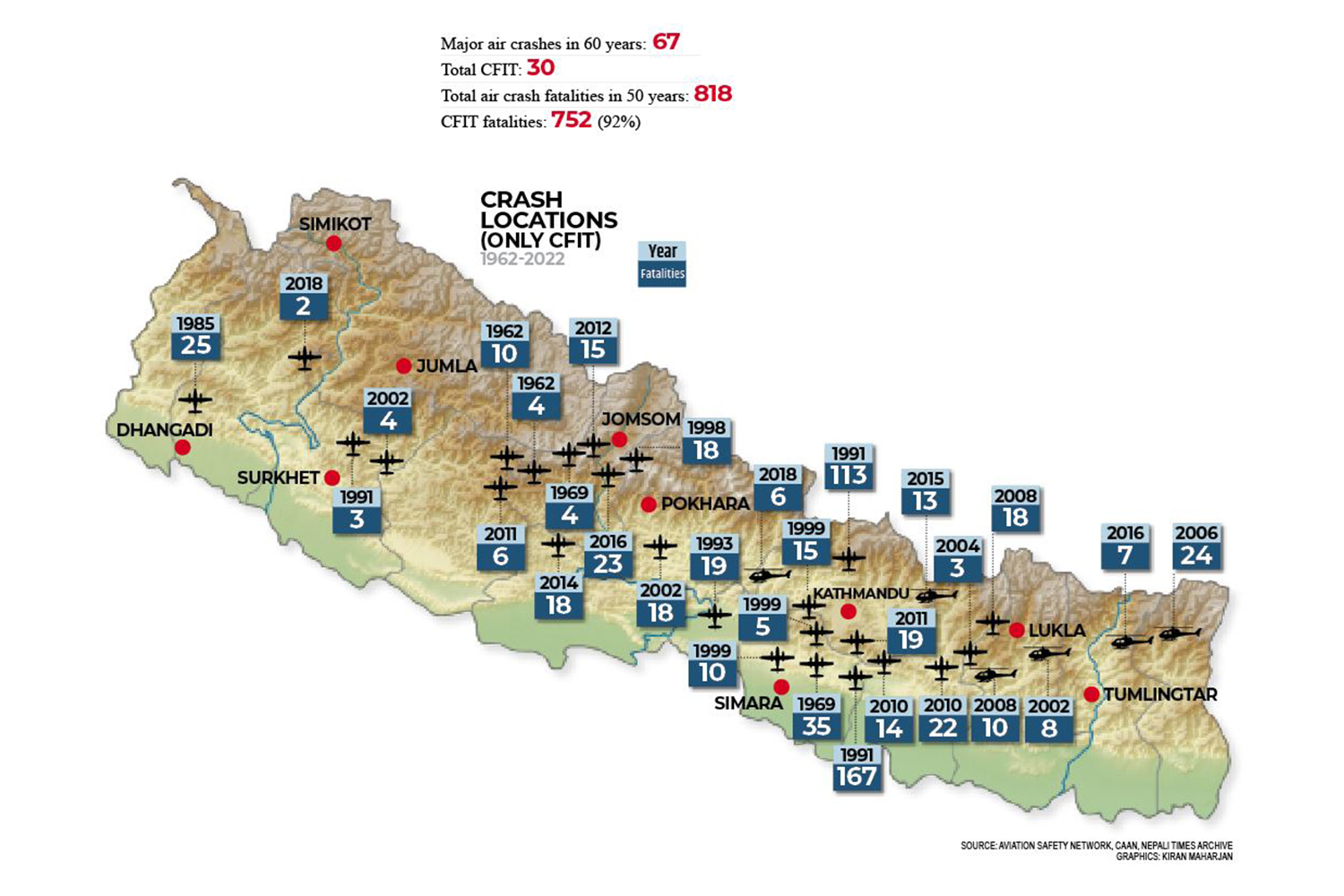
Most aviation accidents in Nepal between 1952-2022 were caused by planes flying into mountains hidden in clouds, known to air crash investigators as Controlled Flight into Terrain (CFIT).
Major air crashes in 60 years: 67
Total CFIT: 30
Total air crash fatalities in 50 years: 818
CFIT fatalities: 752 (92%)
What is it about air crashes in Nepal that very similar accidents tragically keep happening again and again in the same kind of terrain and weather?
A Nepali Times analysis of plane crash data from the past 60 years shows that 92% of the fatalities have been in accidents categorised as Controlled Flight Into Terrain (CFIT) in which an airworthy aircraft slams into a mountain hidden in cloud.
Major Air CrashesNepal is the most challenging country in the world for aviation because of treacherous terrain and weather. Short runways carved out of mountains add to the challenge. Weak regulatory oversight, commercial pressure, failure to follow procedures by flight crew are cited as reasons for most crashes. These sentences from past air crash investigations in Nepal all point to only one type of malfunction:
‘Crew made incorrect judgment of the deteriorating weather condition’
‘Violation of regulation to fly in VFR at all times’
‘Probable cause was continuation of the flight despite unfavorable weather conditions’
‘Ineffective safety and crew training by airline’
‘Inappropriate and insufficient crew coordination’
‘Crew’s over-confidence, casual non-compliance of SOPs about VFR.’
Nearly all major crashes in the past 60 years have occurred on mountain routes. Most mishaps were in the monsoon or during winter rains. Very few were caused by mechanical failure, loss of control, or bird strikes. There have been no fatal crashes on Tarai trunk routes in that period (see map, above).
After every CFIT, investigation reports have pointed to the same reason: failure to abide by Visual Flight Rules (VFR) while flying in the mountains in poor weather. Most cockpit crew, including the ones flying the Tara Air Twin Otter that crashed near Jomsom on 30 May, appear to have been caught unawares by a sudden change in en route weather.
CFITAviation safety experts say this means pilots need to be mindful of not just the weather at the origin and destination airports, but also have precise real-time information of conditions along their flight path. A past crash report recommended equipment to beam live weather conditions on accident-prone routes like Pokhara-Jomsom. The equipment was never installed.
The Civil Aviation Authority of Nepal (CAAN) ought to take a lead by coordinating with the Department of Meteorology and Hydrology to use existing and proposed Doppler radar stations, locating them along dangerous air routes.