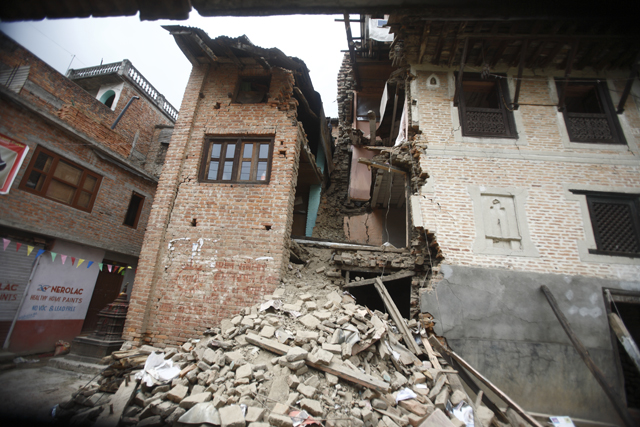
In a narrow alleyway deep in the heart of Patan adjacent to the ruins of a clay-mortar house, a four-storey concrete block stands tall, unscathed except for some minor cracks. In street after street of the ancient towns in the Valley, centuries-old temples and ancestral homes have been reduced to rubble right next to buildings made of cement.
On another narrow lane near Mangal Bazar there is now a pile of bricks where there used to be a house with its first two floors made of bricks and clay. The owner had added three concrete floors on top of it. A family of seven lived there, and four of them were killed when the entire structure collapsed during the earthquake on 25 April. On either side of this house, two five-storey buildings made of reinforced concrete are still standing.
“We learnt during this earthquake that cement houses are stronger," said 41-year-old mother of two, Mira Maharjan, who is afraid that her own brick-and-mud house may not withstand another quake. "But my parents live in a cement house, so I am not worried." Maharjan works in Patan Museum and was lucky to survive the collapse of the east wing of Sundari Chok.
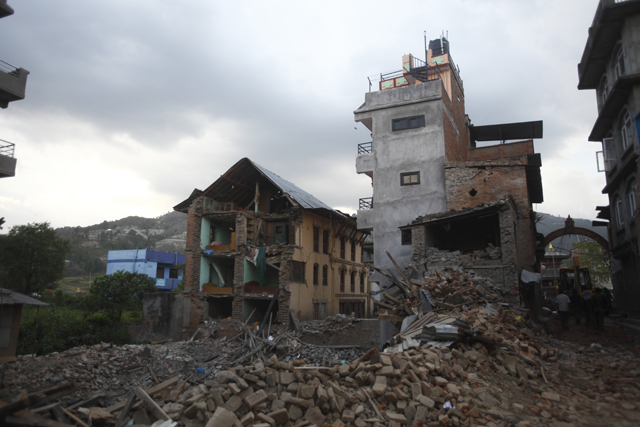
Sankhu. Photo: Gopen Rai
Because so many of Kathmandu's concrete-built structures survived, it has confirmed public perception that these are structurally safer than traditional clay-mortar brick buildings. However, engineers specialising in seismic-resistant housing say Nepalis may have been lulled into a false sense of security with this renewed trust in concrete.
They say the way moulds for reinforced concrete beams and slabs are prepared and the use of substandard raw materials may make these houses less safe in future quakes. Reinforced concrete in itself isn’t bad, but it needs knowhow and training for the buildings to be durable.
“The only reason reinforced concrete structures survived this time was that the intensity and duration of the earthquake was not as big as predicted," said Padma Sundar Joshi of the United Nations Human Settlements Program (HABITAT). "If the intensity was a notch higher and if the shaking had gone on for 10 seconds longer, the reinforced concrete buildings would have also come down."
The 7.3 magnitude aftershock on Tuesday brought down concrete buildings already weakened by the previous quake two weeks ago, and forced the people back to shelters in open spaces. Maharjan who had already gone back to her house, returned to her shelter at the royal garden behind Patan Darbar Square.
“I was taking pictures of the damage of my brick-and-mud house when another one hit us,” said Maharjan. “I don’t know when I’ll go back to my house.”
The problem lies with traditional masons who lack the training and knowledge to ready concrete moulds, and often do not know how to prepare joints for iron rods, they do not following time limits on mixing cement, and design houses with unsafe cantilevers and unnecessary decorations. Joshi warned: “If we don’t change the way we work with cement in Nepal, building more reinforced concrete houses will lead to disaster."