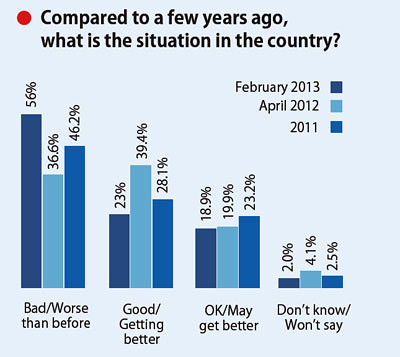
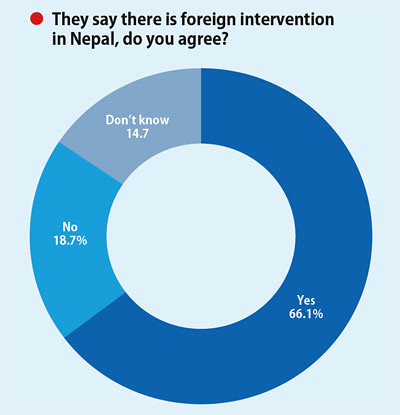
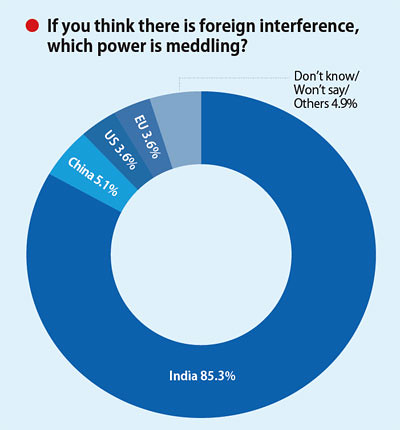
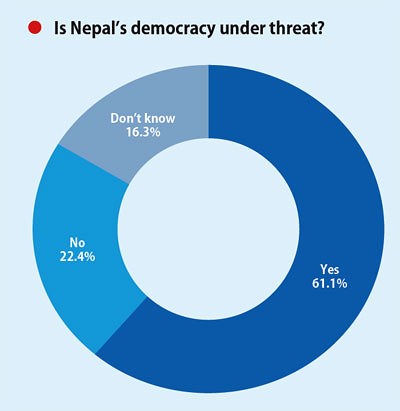
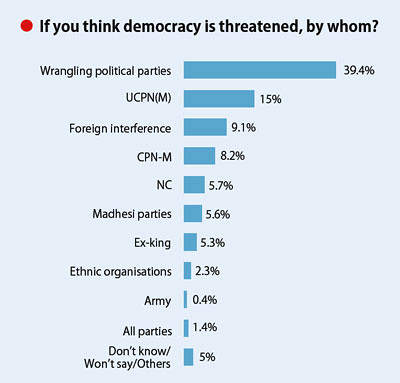
The results of the Himalmedia Public Opinion Poll 2013 give the clearest indication yet of the widespread public disillusionment with the main political parties and their leaders. The euphoria of the ceasefire and the peace agreement seven years ago have all but evaporated. Although the polls in previous years also showed disenchantment with politics, it has never been as quantitatively stark as it is now.
The last Himalmedia Public Opinion Poll was carried out in April 2012, just before the dissolution of the Constituent Assembly. Last year, too, there was scepticism about the commitment of the political leadership about writing the constitution. But it was when the CA’s term was allowed to lapse that the public’s trust collapsed. At no time since the 1990 People’s Movement has the public’s faith in the political parties been as low as it is now.
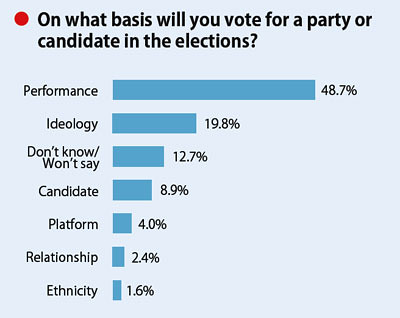
The people either don’t care, don’t know, or won’t say who they will vote for. This apathy is dangerous because it leaves the field wide open for a demagogue. The political parties represent an essential function of a healthy democracy, they are the political entities that ensure representation, accountability, and delivery. At election time the people have a choice, based on the political platforms and the ideologies of the various parties. But this year’s poll shows that the people believe democracy in Nepal is under threat from the behaviour of the political parties themselves.
THE LONG TAIL
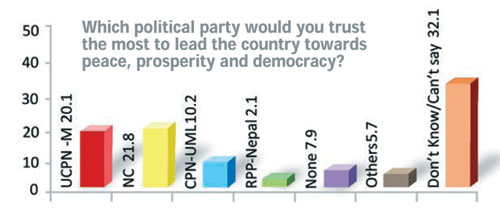
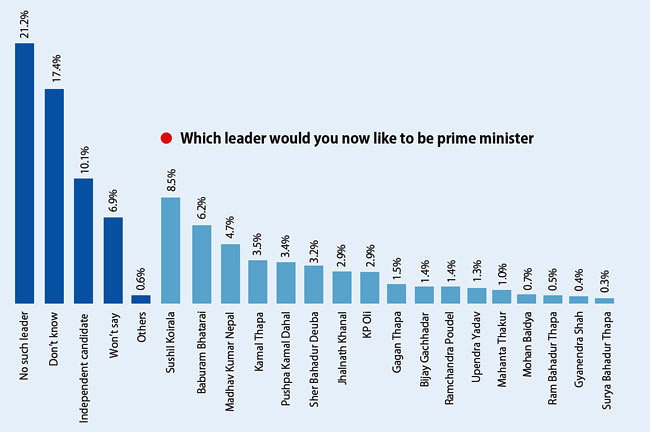
Three questions in the 2013 Poll tried to gauge the relative popularity ratings of the political parties and their leaders. The questions were designed in such a way that they cross-checked each other. The results were consistent in proving that the level of apathy, indifference, disenchantment, and cynicism has grown in the past year.
More than half the respondents don’t trust the present crop of political leaders, whose ratings are all negligible and in the single digits. Combining all those who don’t know, won’t say, feel there is no such leader, prefer others, or want an independent prime minister totaled an astonishing 56.2 per cent.
Although the NC, UML, and Maoists show only between 7-15% in the popularity ratings of the political parties, there is widespread apathy among respondents with 54.1% saying ‘none of the above’. This result should be a wake up call to all, but especially for the Madhesi parties which appear weak even in the Tarai. Any party that can show it means business and can grab even half the undecideds, could win the June election.
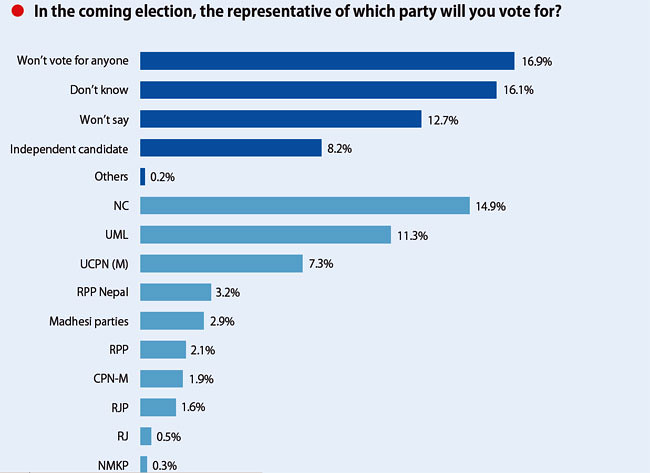
The split in the Maoists appears to have cost both splinter parties dearly. The relatively high approval rating of the NC could be a combination of an anti-incumbency factor to a desire among many to see an end to the political deadlock since it was seen to be the NC’s ‘turn’ to lead an election government. Despite this, a full 45% of the respondents were noncommittal and didn’t express their preference.
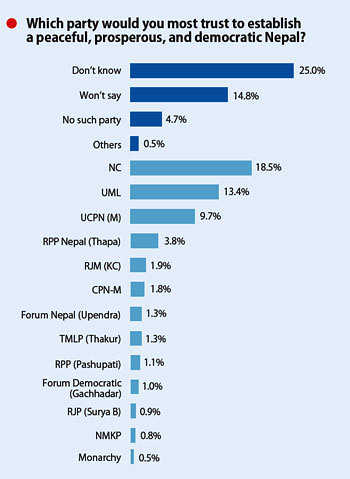
OTHER POLLS
Paradoxically, even though the parties and their leaders have lost their standing among voters, most respondents still haven’t given up completely on them. Previous polls also showed people expect the most from the three big parties, like this Himalmedia Poll in 2011.
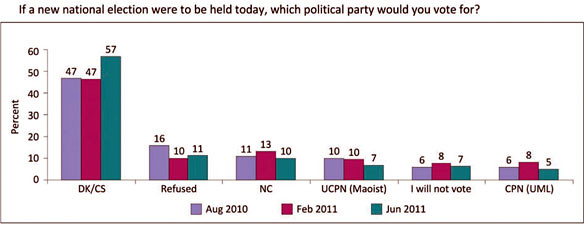
The results of the Himalmedia poll also correlate precisely with similar nationwide polls with sample size of 3,000, like this one carried out by Interdisciplinary Analysts (IDA) in 2011.