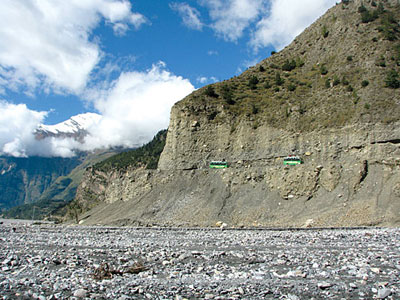
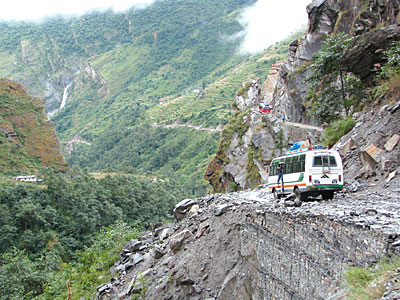
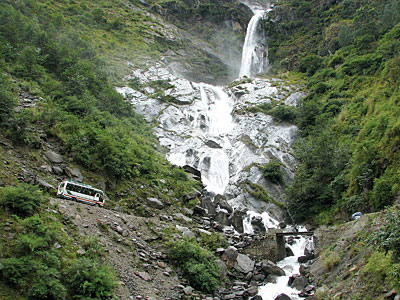
Upwards from the Rupse Chahara in Kabhre village in Myagdi district, the Kali Gandaki river narrows as it tumbles and rumbles its way through a steep, deep gorge. The power of the muddy river as it pounds on the rocks can almost be felt a hundred metres or so above on the equally narrow track that winds its way treacherously towards Mustang. Yes, a track. One can't quite call it a road, not yet!
Travelling through this deep gorge between two 8000-metre peaks, there is a great sense of awe and humility. Maybe it's the timelessness of the river that down the millennia, has been relentlessly cutting through the tough rocks in its search for the southern plains. It makes one seem so miniscule, insignificant and transient. The rock face now sports graffiti in many places.
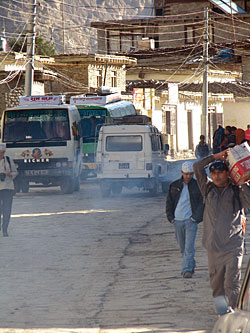
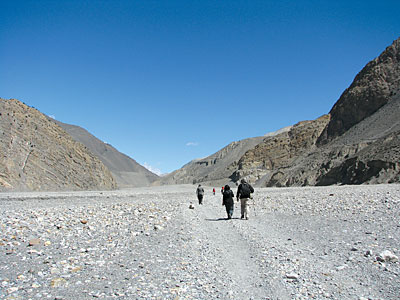
Walking along these precipitous slopes is nothing compared to the adrenalin rush as one bumps and sways inside cramped buses along the one-monsoon old gravel track. Once the gorge opens up to the wide Kali Gandaki Valley, where the river flows relatively sluggishly, meandering from one bank to the next, it is a different story. Pedals hit the metal as the buses hurtle forward on the straight stretches, blowing their pressure horns impatiently to scare off trekkers straggling along the road. The horns echo back and forth along the contorted and pristine trans-Himalayan hillsides.
"One has to blow the horn continuously," explained one microbus driver as he dashed over the river bed past Kagbeni. "Otherwise these trekkers won't hear us through their head-phoned ears!"