
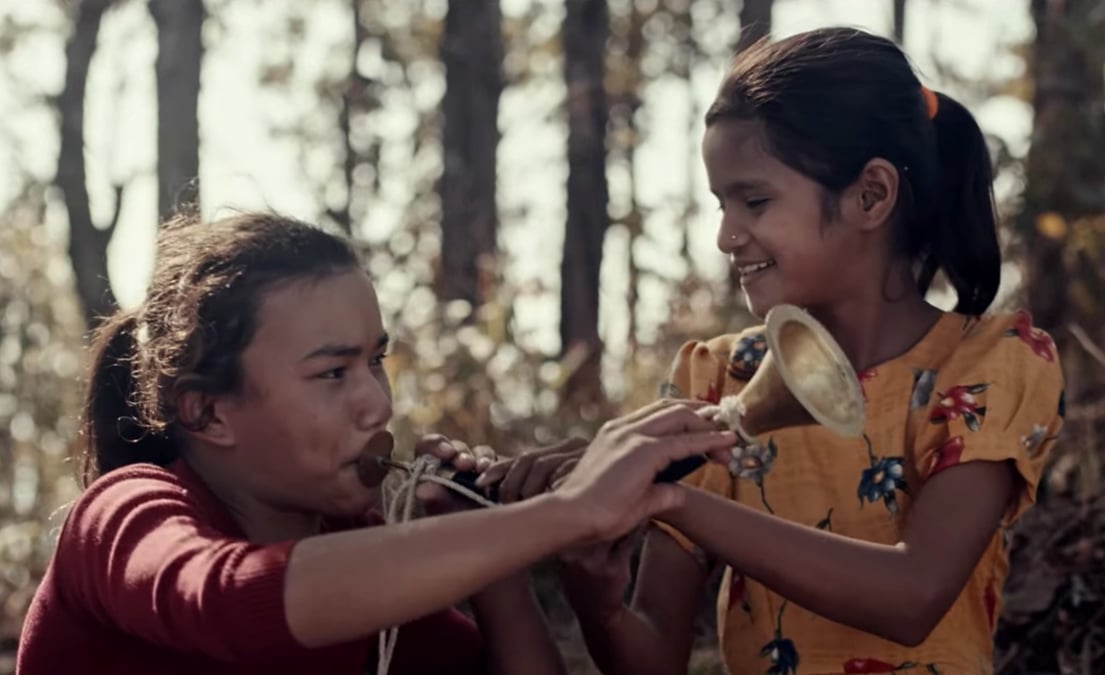
Bigotry is not innate, it is learned behaviour — that message is front and centre in Akanchha Karki’s short film, Sanai.
The film won best director, best cinematography, best story, best original score, and best picture at Malaysia’s Neo South Independent Film Festival as well as awards at the Nepal Human Rights International Film Festival and the Nepal America International Film Festival.
Sanai is the story of Rupa and Maya, two teenage Dalit and Brahmin girls form an unconditional friendship within a patriarchal, caste-ridden society. The film starts with Rupa’s father heading to Maya’s house to play the sanai, a musical instrument of the Dalit community at the wedding of Maya’s uncle.
Dialogue and the behaviour of characters allude to or explicitly exhibit the caste divide. Maya longs to play the sanai, but is yelled at by her mother for ‘almost causing a disaster’ when she tries to reach for one of the instruments.
Rupa’s mother mends clothes for Maya’s mother and sends Rupa to deliver it, but Maya’s mother will only touch the clothing after ‘purifying’ it first.
However, the two children, brought together by their shared love of music, rebel in their own ways. Rupa throws away the sel roti dropped onto her hand without touching it by Maya’s mother. Maya refuses free candy given to her to persuade her to stay away from Rupa.
At the wedding, Maya defiantly plays the sanai given to her by Rupa during her uncle’s wedding.
After Maya is told by an adult not to hang out with Rupa due to their caste difference, there is radiant joy when the two girls are told by their teacher that Rupa should ask her mother to sew her the same frock as Maya so that they can look alike.
The following scene, where Maya and Rupa exchange their clothes with Rupa wearing Maya’s prettier outfit, is among the most quietly powerful moments in the film.