
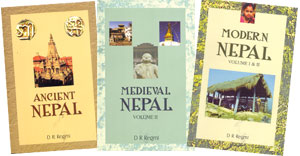
 Dilli Raman Regmi's massive history of Nepal from antiquity up to 1814 is itself of historic importance. Regmi was the first scholar to explore in elaborate detail the political, economic, social, and cultural aspects of Nepal in antiquity and medieval times and help make the case for Nepal as an independent entity.
Nepal scholars and enthusiasts will be pleased to know that New Delhi-based publishers Rupa & Co, in association with the Dr Dilli Raman Regmi Foundation in Kathmandu, have re-issued this seminal work in four parts-Ancient Nepal, Medieval Nepal Vols I and II, Modern Nepal Vols I and II. The reprint rolls the four volumes of Medieval Nepal into two volumes and the two of Modern Nepal into one.
Nepal's changing political scenario has affected interpretive and analytical approaches to history. After the fall of Rana rule in 1951 local and foreign scholars started undertaking exploratory and analytical research on Nepal's history. Today, historians can write frankly without fear of censorship or retribution and there are now new authoritative scholarly texts. But first there was DR Regmi.
Regmi started writing about Nepali history, politics, and economics in 1942, Most of his books were published by Firma KL Mukhopadhyaya, Calcutta. Ancient Nepal was first published in 1960 and enlarged in 1969. The author's meticulous research results in a political history of the Licchavi period's kings, polity, economy, and foreign policy, and society, and analytical descriptions of the culture, art, architecture, and sculpture of the time.
Regmi's assessment of the importance and utility of various source materials connected with this period of Nepal's history remains valuable. The two volumes of Medieval Nepal present a short history of the kingdoms of the time covering the areas including and around present-day Nepal. Regmi details the Khasa Malla kingdom extending from Garhwal (in present-day India) in the west, to the Trisuli in the east, Manosarovar and Taklakhar area (in present-day Tibet) in the north, and the tarai in the south.
The Karnata kingdom with Simroangarch as capital extended from the Mahabharat range in the north, to Bodh Gaya and the Ganga in the south, the Gandaki in the west, and the Kosi in the east. Also covered are the the baise principalities in the Karnali basin area, the chaubise in the Gandaki basin area, and the three Sena kingdoms of the eastern Nepal. Finally, there are the three Malla kingdoms that ruled from the three towns of Kathmandu Valley from the Trisuli in the west, the Dudh Kosi in the east, Kuti and Kerong (present-day Tibet) in the north, and to the Mahabharat range in the south.