
20 killed in jeep crash, Rolpa 30 April
13 students injured in bus accident, Jhapa, 30 April
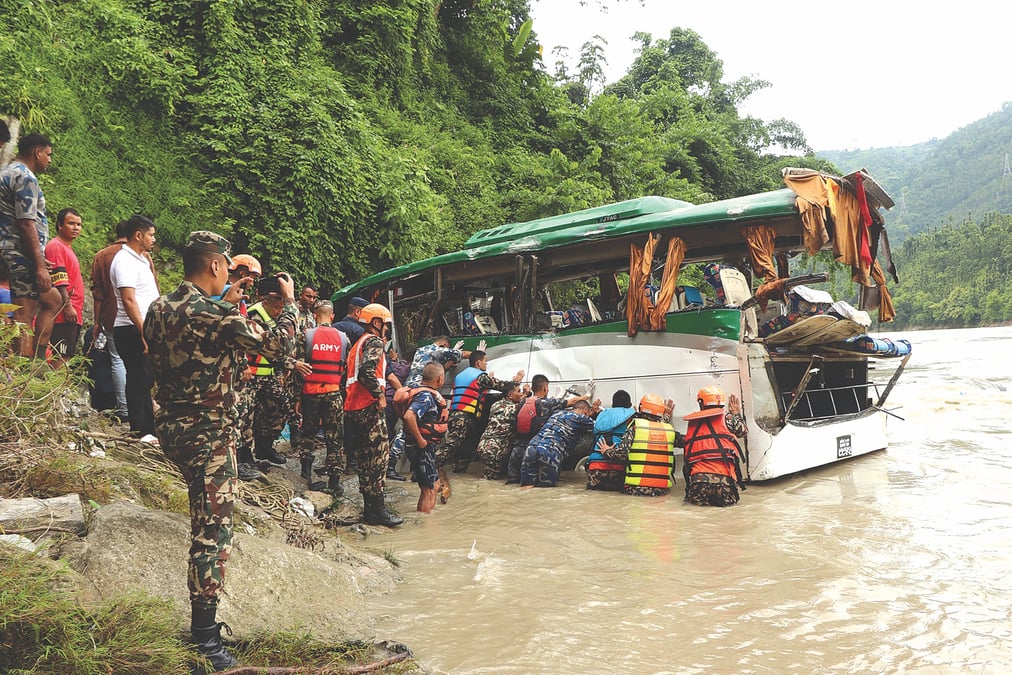
19 die in bus accident, 25 injured, Dhading, 23 February
Nepal has the highest per passenger kilometre traffic fatality rate in the world, with more than 4,500 people killed on its roads and highways every year. Upgrading road safety could save at least 40,000 lives in the next ten years.
The jeep that plunged off the a mountain road in remote Rolpa last month had a capacity for 10 passengers, but it was carrying more than double that number, and 20 of them died when the vehicle fell 500m into the valley below.
I have been writing this automobile review column for Nepali Times, and have my own YouTube channel with driving tips. But being on the road for as much time as I do, road and highway safety (or the lack thereof) has always been what worries me a lot.
Recently, I had just shut down my cameras and was packing my equipment after test driving the
, and my mind was at ease as I began to flip through the checklist of shots that I needed for my video. I had parked the car on the left shoulder of the road on the way to Godavari.
Suddenly there was a screech of tyres followed by a loud crash and bang. It was a young speeding biker who had collided with a mother and her child crossing the road on a scooter. After seeing this unfold on my rearview mirror, I quickly jumped out to check up on them. As usual, a crowd of locals had already gathered.
The biker was crouched down on the side of the road, pressing onto his knee. His bike was lying sideways on the ground further ahead, grease and oil oozing onto the tarmac. The mother knelt down, hugging her child checking if she was ok. The scooter’s front had absorbed most of the impact and splintered into pieces. Thankfully, casualties looked minimal.
This is just one of the many ‘accidents’ that can easily turn deadly on Nepal’s roads and highways. Highway fatalities are the biggest killers of young people in Nepal, half the accidents every year involve motorcycles, and two-thirds of the fatalities involve bike drivers, pillion riders, or pedestrians hit by two-wheelers.
As vehicles get more sophisticated and powerful, and the highway infrastructure improves, vehicles are moving faster and over longer distances. But awareness about road safety has not risen with the same velocity. Pedestrians, meanwhile, are not used to the higher speeds on highways when they cross the road.
On Saturday morning on 1 May, I woke up to yet another headline about the Rolpa jeep disaster. Nepal sees on average 75 road accidents daily. Sometimes it’s two two-wheelers in collision, and more and more often it is a bike and car hitting each other. Documentation of multi-vehicle-collisions are on the rise.
Growing up, 1,200cc engines were already considered powerful and proper two-lane highways were wide enough to handle traffic. The numbers of vehicles have grown, while urban roads have stayed the same. The average bike has gone up from 100cc to 250 and above, while cars have risen from 1,000cc to more than 1,500. And that is without calculating instant-torque and capacity electric vehicles provide. And most importantly, those two-lane highways have expanded to eight-lanes like the Ring Road or the Pokhara highway.
The new government under Prime Minister Balendra Shah’s RSP has pledged to act to reduce road and highway fatalities. Traffic police have ramped up issuing fines for road rule violators. At every busy intersection, officers in blue uniforms are busy policing both two and four wheelers to not only follow the traffic lights, but also maintain lane discipline.
And while the number of fines and overall policing have improved in urban areas, common sense and etiquette on the road has not improved on the highways. Habits like not overtaking on a blind turn, or maintaining braking distance at higher speeds is grossly overlooked. Such driving behaviour not only endangers one’s own vehicle and passengers, but also those on the road.
Safety on the road has a multiplier effect. If one drives safely, around 20 people are safe, but just one dangerous driver can endanger the lives of those 20. This is not all to say that the entirety of the blame is irrational human behaviour – bad road conditions compound the problem.
Lack of properly built roads with safety infrastructure, railings, markings and signage can make the difference between life and death when frequently used highways are dusty, rocky and slippery.
Even as I continue to share road experiences through POV vlogs on YouTube for cars and bikes, the harsh truth is that public attention often comes only after tragedy strikes. If the speeding biker had just slowed down given that it was a busy area, and if the scooter had stopped and looked both ways patiently before merging onto the road, think how differently things might have turned out for all concerned.
Arnav Upadhyay is a content creator who reviews automobiles and promotes road safety for his Nepali Times column, Drive Line. He is also on Youtube, Tiktok and IG under the handle Casually Annoyed Driver.