
|
|
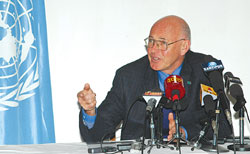
A week after UNMIN chief Ian Martin announced the number of Maoist fighters and weapons registered so far, controversy is still raging. The weapons-to-fighter ratio, which is about 1:9, appears too little. Many analysts have questioned how is it possible that the Maoists have only 3,500 odd weapons when their fighting strength is nearly 32,000? Some experts and politicians are asking whether the ratio be more like 1:1?
This debate, though justified in many ways, misses a few key points about the Maoists. While it is important to account for each and every Maoist fighter and weapon to move the peace process forward, it would be foolhardy to expect that the Maoists will register all weapons in their possession.
No rebel force in the world does that. The level of mistrust between the rebel and government forces is still too high at this early stage of the peace process for the Maoists not to have concealed some of their weapons. And besides, as anyone who followed the conflict over the years should know, the Maoists' main weapons were threats, intimidation, socket bombs and other improvised explosive devices, rather than the antiquated three-nought-threes.
Second, while the number of government weapons lost to Maoist rebels during the conflict and the number of Maoist weapons registered so far by UNMIN do not match exactly, they are tantalisingly close. Little attention has been paid to senior Nepal Army officers who have recently publicly said they are satisfied with the Maoist weapons. They say this because the number comes close to their own figures and also estimates of Maoist weapons by various research and intelligence agencies. There are some weapons which are still missing, of course, but they can be explained: the Maoists too lost some of their weapons, to rebel groups like Jwala Singh and Jai Krishna Goit.