
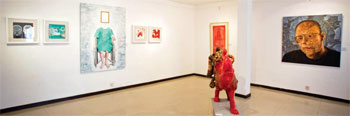
Spread across all three floors of the gallery, each art piece is distinctive of the artist who created it. While no two pieces are alike, most take inspiration from Nepal’s current state, be it cultural or socio-economical, and are presented as paintings, etchings, sculptures and mixed media installations.
One of the most extensive presentations within the exhibition is the painting series The Blank Frame by Hitman Gurung. Consisting of five different sets of paintings, the central piece (see pic) depicts a faceless hospital patient sitting in a wheel chair, his face replaced by an empty frame. The four smaller paintings of a CT scan, hospital equipment and blood depict the process of surgery. Similar to his previous exhibition I Have to Feed My Country and My Family, that was shown in February at the same gallery, Gurung says he was inspired by the true story of a Nepali migrant worker in Malaysia who suffered a brain hemorrhage and had to return back to his village in Dhankuta.
In placing the lone figure against a backdrop made up of a collage of pictures of Nepali migrant workers, the artist highlights the collective struggles they have to go through.
“My work is a metaphor for the countless victims of labour that return from working abroad,” said Gurung.
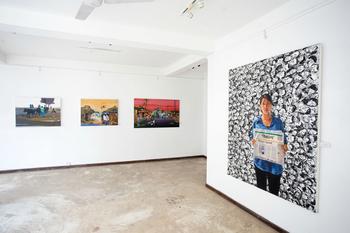
As an annual program hosted by the gallery, it gives space to established artists as well as up and coming artists. The exhibition runs until 28 July. The artists featured are Aditya Aryal, Prabin Shrestha, Arjun Bhandari, Prithivi Shrestha, Arjun Khaling, Ram Maharjan, Hitman Gurung, Sagar Manandhar, Jasmine Rajbhandari, Sanjeev Maharjan, Rajan Pant, Saurganga Darshandhari, Kailash Shrestha, Sheelasha Rajbhandari, Lavkant Chaudhary, Shraddha Shrestha, Manish Harijan, Sudeep Balla, Mekh Limbu, Sunil Sigdel, Mukesh Shrestha, Surendra Maharjan, Muna Badel, Sushma Sakya, Narayan Bohaju and Suvas Tamang.
Ayesha Shakya
Amalgam-2014
27 June to 28 July 2014
Siddhartha Art Gallery, Babar Mahal Revisited