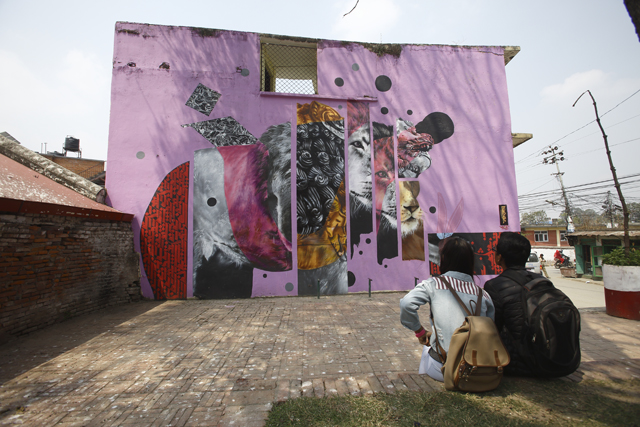
For past weeks a colourful mural has come up on the wall of the Lalitpur District Post Office in Patan Dhoka (above) depicting a combination of lions and humans to illustrate the characteristic they share: pride, one of seven deadly sins.
Created by street artist Kiran Maharjan, the three-storey painting is one of many works of art that will adorn the streets of Patan and Kathmandu for the next 17 days – part of an international festival called the Kathmandu Triennale. Maharjan’s mural encapsulates what the festival hopes to promote: the existence of art beyond the confines of a gallery space.
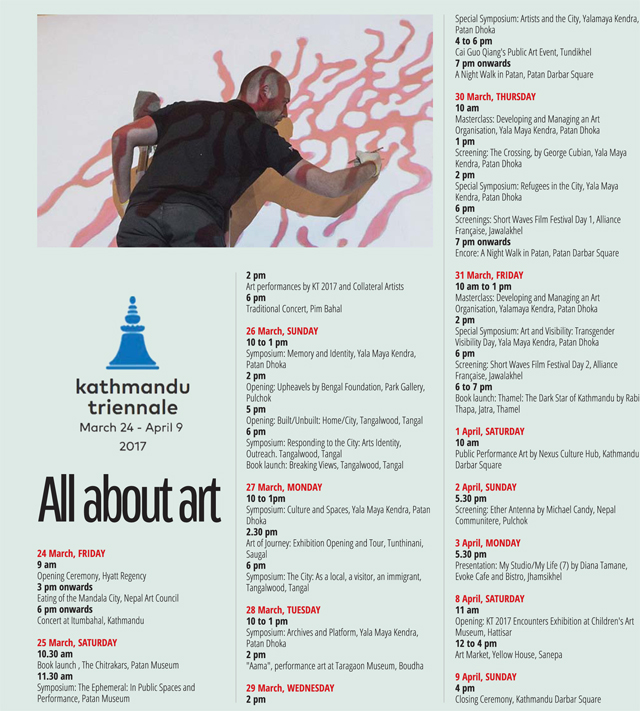
“We see Kathmandu Triennale 2017 as an opportunity to develop newer audiences while bringing art lovers deeper into the passion for art,” said festival manager Nischal Oli. With the theme ‘The City: My Studio/The City: My Life’, the festival is expecting over 70 artists from 25 countries from 24 March - 9 April.
"The focus is on the city because cities all around the world are changing and are in a constant state of flux. The festival will look at how changes or the status quo affect us as individuals, as citizens or as artists," said festival director Sangeeta Thapa.
The Triennale will be centred in four venues: Patan Museum, Nepal Art Council, Taragaon Museum and Siddhartha Art Gallery, as well as other galleries. But the whole city is the venue.
“We should not focus on the effect of art, we should just do it,” said Philippe van Cauteren, curator of the central exhibition of the festival, who is also the artistic director of SMAK Museum for Contemporary Art in Ghent, Belgium. Van Cauteren has curated festivals in Chile, Mexico, Germany and Brazil, and gave the Kathmandu festival an international focus.
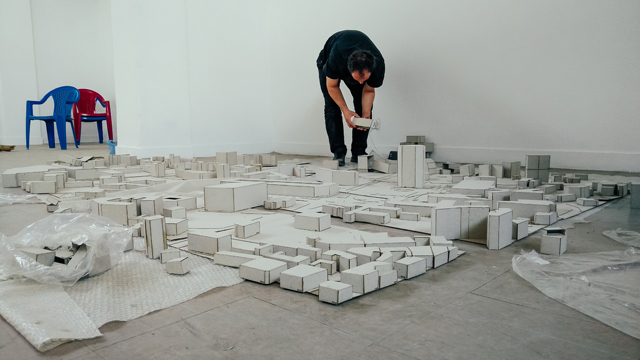
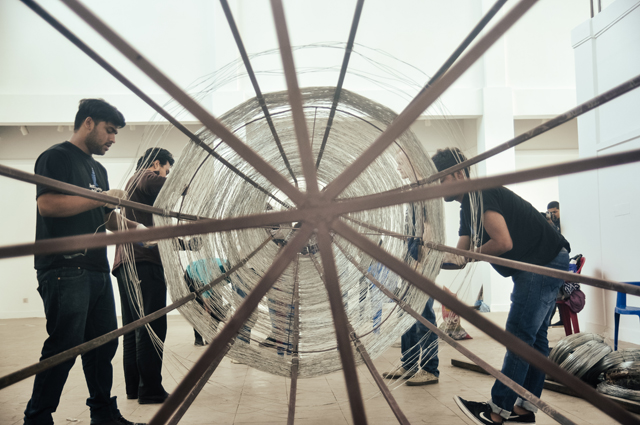
In the months leading up to the festival, Nepali and international artists have taken the opportunity to make Kathmandu their muse as well as studio space. For artist Sujan Dangol it has been nothing short of an eye-opening experience. Recounting stories and anecdotes of his work with urban refugees in Kathmandu over the past two months, Dangol says he has had a lot to learn.
“People play musical chairs for fun, but in reality we are actually playing musical chairs,” said the artist, who uses the well-known game in his video to depict the harsh uncertainty of people living in tempoerary camps, especially after the earthquake.