
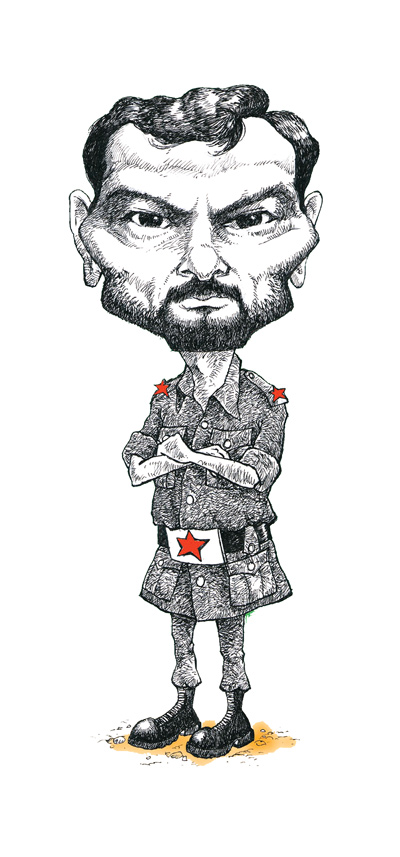
This week marks 20 years since the start of the Maoist conflict, and in a few months it will be 10 years after it ended.
It was Baburam Bhattarai of the Samyukta Jana Morcha, the electoral avatar of the underground Maoists, who on 4 February 1996 presented the government of Prime Minister Sher Bahadur Deuba with a list of 40 demands that he wanted fulfilled in two weeks ... or else.
Deuba did not pay much attention, as he was unduly distracted with infighting within his Nepali Congress party and an impending visit to New Delhi. Bhattarai never intended to wait two weeks anyway, and launched simultaneous attacks on police stations across the country on the night of 13 February 1996. A day before Valentine’s Day, the Maoists went on the warpath.
The attack on the Holeri police station was led by Barsha Man Pun (currently secretary of the UCPNM and former finance minister) and Nanda Kishor Pun (now Nepal’s vice-president).
Bhattarai knew that many of the 40 demands were not within the Prime Minister’s power to fulfill: like clipping the wings of the king and royal family, removing ‘unequal’ clauses in the 1950 Indo-Nepal treaty, and scrapping Gurkha recruitment. And there were absurd demands that seem to have been included just so that the list would contain a total of 40: banning ‘lurid’ Bollywood movies, and ‘ending cultural pollution’ of the nation. So, Deuba took off for New Delhi and it was while he was still in India that he heard that the Maoists had started a war back home.
There was much -- and fervent -- hope for democracy and development after the street protests in 1990 that led King Birendra to lift the ban on political parties and the writing of a new constitution. The press was unshackled, and foreign investment flooded into the country. Local elections ensured accountable leaders, and for the first time, democracy delivered development.
Yet, democracy was slow to address entrenched social inequity, social injustice and structural discrimination. The Maoist war set out to address these problems, but as Professor Krishna Khanal tells our correspondent Om Astha Rai on page 14-15, the 40 points were just a ruse for the Maoists to get to power. And because the objective conditions for revolution were so explosive, the spark they lit in Holeri in 1996 spread like wildfire across the country. A feckless state fanned the flames with characteristic mismanagement and apathy. When the state did act, security forces unleashed brutal crackdowns in the Maoist heartland, pushing ordinary people -- who had wanted no part in the war -- to the Maoist fold.