
Two hundred years ago this week, troops of the East India Company were advancing on Makwanpur Gadi, the hilltop fort guarding the southern approaches to Kathmandu Valley. The British wanted to teach the Gorkhali Kingdom a final lesson, and force its rulers to ratify the Sugauli Treaty that had been signed four months previously. As Jyoti Thapa Mani recounts in her recently-published book, The Khukri Braves the heroic but demoralised Gorkhali defenders did not stand a chance when the Company brought up heavy artillery.
1815 marked the peak of the Gorkha expansion, with Makwanpur being the last surrender. It was all downhill after that. The Sugauli Treaty allowed Nepal to remain independent and isolated, but it sanctioned the appropriation of nearly half its territory, and started the practice of the recruitment of Nepalis into the foreign military which continues 200 years later.
Nepal was economically ruined by the war, and the loss of so much territory also meant an acute loss of tax revenue. The fighters were abruptly jobless, and the first seeds of what is now Nepal’s inescapable migrant economy were planted then: we started exporting young men to fight for a foreign army. Soon, there was a massive exodus of civilians, too, from Nepal’s mid-hills to India’s northeast and Burma.
The British didn’t just conscript soldiers, they also recruited indentured labourers for the sugarcane fields of the West Indies and Fiji. Many Nepalis were among those who sailed off from Calcutta, including the ancestors of Vidiadhar Surajprasad Naipaul, the Trinidadian Nobel Prize-winning author.
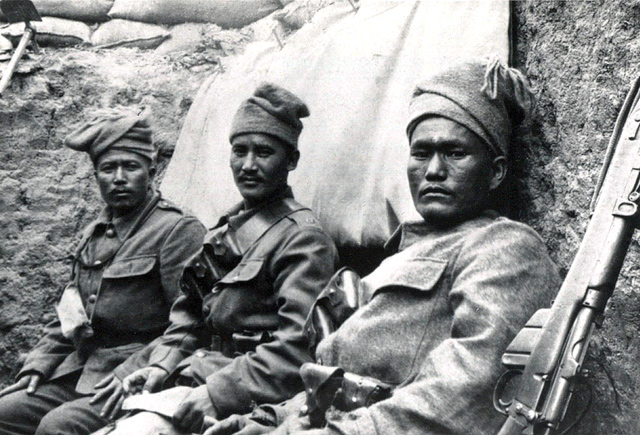
The first Gorkhali fighters joined the Company even before the war formally ended. For two centuries since then, the British Gurkhas (called 'Gorkhas' in the Indian Army) have fought for the Empire. A total of 52,000 young Nepali men died during the two World Wars, emptying Gurung, Rai, Limbu and Magar villages of young men.
Nepalis are rightfully proud of the fact that our country has never known a colonial master. However, that was not because British India or China-Tibet could not overrun Nepal, but because they chose not to. It was strategically much more advantageous, and cheaper, to keep Nepal as a buffer. Both the British and the Chinese had sent their armies into Nepal, and what they saw of its topography convinced them that the unforgiving terrain made it virtually ungovernable.
Jang Bahadur, the ambitious general and progenitor of the Rana dynasty, initially aspired to restore Nepal to its former glory. To gauge whether it was worth going to war to regain territory lost in 1815, he became the first subcontinental royal to cross the Black Waters to pay state visits to Britain and France in 1850. He was suitably impressed with British military prowess, and his descendants became devoted to the English, offering troops to quell the Mutiny in 1857, the Afghan Wars and other campaigns.