
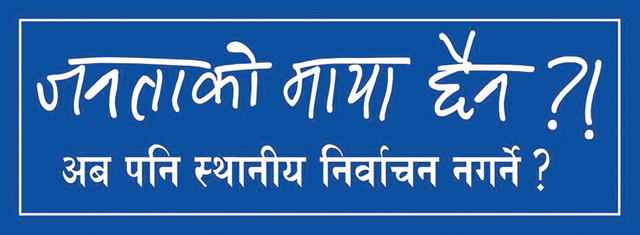
Nepal has not held local government elections since 1997. It has been a decade-and-a-half since the last elected district, village and municipality councils were dissolved. The Federal Democratic Republic of Nepal has been run by unelected bureaucrats at the grassroots for the past 15 years.
In the early 1990s, Nepal was beginning to see the first signs of how local democracy could better deliver services in this rugged and predominantly-rural country. Backed by the Decentralisation and Self-Governance Act, local bodies were – for the first time in Nepal’s history -- forced to be accountable, because they were elected.
Development took off, with remarkable improvements in rural health care, school enrolment, community forestry, village-managed irrigation, and credit and savings schemes. It was largely due to decentralised decision-making that Nepal saw dramatic improvements in female literacy, which in turn sharply reduced both infant and maternal mortality rates. The momentum of the changes that swept rural Nepal is still being felt today in health and education.
The Maoist conflict was the ruse Nepali Congress prime minister Sher Bahadur Deuba used to cancel local elections in 2002, when in fact he feared that the UML would once more dominate village and district councils. What he did not anticipate -- or could not have cared less about -- was that the Maoists would use the vacuum at the local level to spread their influence, which is exactly what happened. The rebels used terror tactics, threatening elected local councilors and killing those who refused to toe the line, they bombed most of the 4,000 VDC and 75 DDC buildings.
After the conflict ended, the presence of elected officials at the grassroots would have streamlined compensation for victims and their families. Local accountability would have also ensured more timely and efficient delivery of relief after last year’s earthquake. In the year after the earthquake we have seen CDOs and LDOs in many of the 14 districts doing a commendable job with emergency response, but in the presence of elected local councils they would have performed even more effectively distributing reconstruction grants, rebuilding schools and repairing infrastructure.
National-level politicians are too busy bickering for power, or arguing about the new constitution, to pay attention to local elections. They spout the ‘federalism’ mantra, but they stopped practicing decentralisation long ago. Federalism is nothing more than self-governance and autonomy for local units of government, but Kathmandu today is more centralised than ever. Bureaucrats sent by Singha Darbar decide where to spend earthquake money or the development budget, even as politicians argue endlessly about the form of federalism and the boundaries of proposed provinces in the Tarai.