
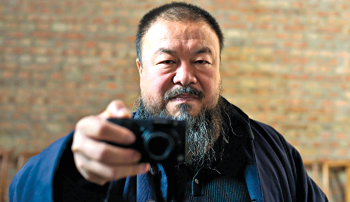
In 2008, Alison Klayman, a TV producer for PBS and NPR, met an extraordinary man called Ai Weiwei in Beijing. I say ‘man’ and not ‘artist’ because while Ai Weiwei’s deeply conceptual art has made him undeniably famous, it is his humanity in its entirety that feeds his art and makes such an unforgettable impact on all who come into contact with him and his work.
Weiwei, as he is called by his contemporaries, friends, and followers, is a burly man, teddy bearlike, with a jolly laughing face, and a beard that only adds to his general air of benevolence. Slowly though, through over the course of Klayman’s documentary, the steely moral interior behind this avuncular façade starts to emerge making it apparent that Weiwei is a knight in shining armour behind his seemingly soft exterior.
Today Ai Weiwei is famous as the dissident artist who fearlessly stands up to that opaque and formidable edifice that is the Chinese government. In addition to speaking out for every kind of freedom of expression in his beloved China, Weiwei also actively tackles the machinations and the systemic corruption of a government that refuses to be criticised; actively cooking up charges and excuses to implicate and imprison any and all of its detractors.
It is when Weiwei, horrified by the loss of thousands of children’s lives in the 2008 earthquake in Sichuan due to substandard government schools, takes up the internet as his weapon to expose the establishment’s shoddiness that he truly draws attention to himself.