
While many newlyweds have left for their honeymoons in Pokhara or Chitwan, other young couples are making the rounds in Kathmandu’s crowded court rooms seeking to divorce.
Usha and Bibek are among them. They filed for a divorce in Kathmandu District Court earlier this year and it was finally approved last month. Their marriage did not even last a year.
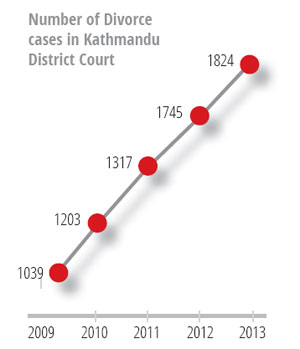
The number of divorces has doubled in the last five years to 1,824 in 2013, most of them filed by women. One in ten family-related cases filed in the courts are divorces, and have overtaken cases relating to land, money lending, and inheritance. “The rigid boundaries governing traditional Nepali life are starting to crumble and so is the notion of marriage. People are embracing divorce as an option if they cannot get along,” says advocate Sapana Pradhan Malla. “However, only a small section of the urban population is socially and economically empowered to exercise these choices.”
Women can directly file a case for divorce in Nepal’s courts, whereas men have to appeal through the local Village Development Committee or Municipality. But women’s rights activists caution that more women filing for divorce doesn’t always mean empowerment.
Malla explains: “Many women who file for divorce may not be making free choices because most of them get nothing or very little from their husband’s property share after divorce.”
Polygamy is illegal, and in most cases men force their wives to file for divorce in order to let them remarry. According to Nepali law, if a wife takes her share of property, her husband is allowed to remarry without divorcing his first wife.
Women’s rights activists say that such provisions encourage and abet polygamy. Although the 11th amendment to the Muluki Ain, which entitles daughters to inherit property at birth, might have improved the chances of social and financial safety for women after divorce, not all women have the upper hand in such negotiations.
While 28 year-old Usha did file for a divorce in a court, she had to agree on an out of court settlement. She was unable to afford legal fees to fight for a part of Bibek’s property . “It could have taken me years to get my share of the small plot of land that I was entitled to after divorce, so I decided to settle,” she says.
Usha says she would have not filed for divorce if she didn’t have a supportive family and a stable job. “I may have committed suicide if I had to endure the mental torture from my in-laws,” says Usha, who admits she made the wrong decision to marry in a hurry due to family pressure.
Psychologist Karuna Kunwar, who counsels young married couples, says that societal pressures to get married against one’s will is a major factor in failed marriages. “Young people’s aspirations are radically different from that of their parents and grandparents and when they are forced into marriage, it falls apart quickly,” she says. Although there are no national statistics on divorce, sociologists say that changing livelihoods coupled with urbanisation are leading to new dynamics of married couples in both urban and rural areas.