When Nepal Electricity Authority (NEA) Chief Kulman Ghising restored uninterrupted electricity supply seven months ago, his predecessor Mukesh Raj Kafle challenged him to sustain it through the winter. Ghising not only did that, he ensured consumers did not suffer power cuts in the following dry season as well.
He accomplished that by managing distribution, stopping big companies from bribing NEA officials to ensure 24 hour power, and importing electricity from India to cover the shortfall. However, even Ghising now admits that he may not be able to prevent power cuts this winter.
It is the simple arithmetic of supply and demand: peak demand this winter can reach 1,550 MW but there will only be 1,000MW of supply from domestic sources and imports from India (see graphics).
“Our priority is to manage power supply by generating more electricity from new NEA and private hydropower plants to end load-shedding in winter, but we also plan to reduce demand by promoting energy efficient programs and introducing solar net metering,” Ghising told Nepali Times in an interview his week.
Ghising’s strategy for this winter is to reduce demand by a mass nationwide replacement of 20 million incandescent bulbs with efficient light-emitting diode (LEDs). But when he announced this plan in April, there was an uproar in the media over alleged corruption in the government-to-government deal to import the bulbs from India.
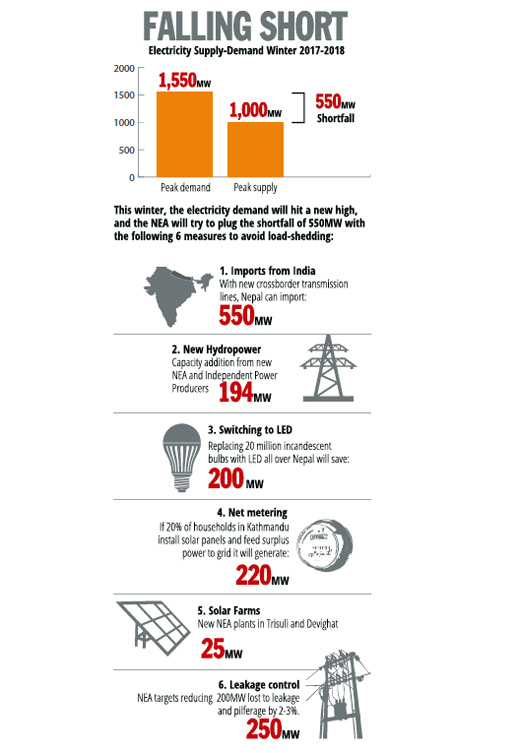
NEA plans to sell 9 watt LED bulbs from Philips with a three-year warranty for Rs 140 each. The bulb’s market price is above Rs 500. Ghising hopes that when all 20 million bulbs are distributed, the grid will save up to 200MW this winter.
“That is like adding an expensive new 200MW hydropower plant that would take years to build,” said Ghising, who brushed aside criticism of the deal. “Look, I am not in the bulb business. People now understand that they were being ripped off buying expensive bulbs, so there was resistance from some quarters.”
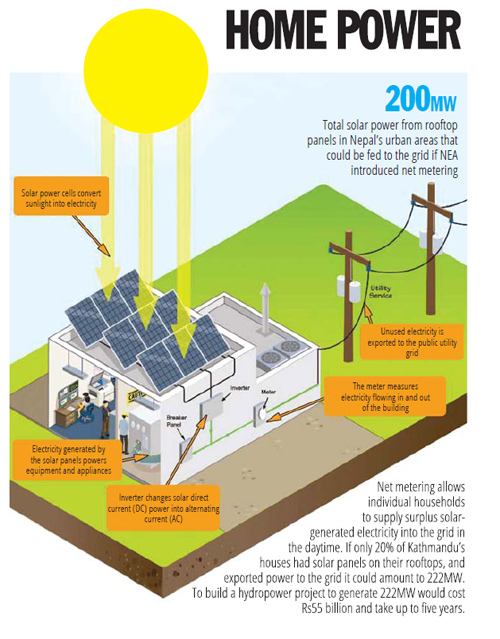
NEA’s other plans are to further reduce demand by encouraging people to use energy efficient fans, tv sets and refrigerators. It is also reviving a scheme first mooted by Water Resources Minister Dipak Gyawali in 2005 to install net metering (see box) through which every household with a solar panel can sell surplus power to the grid.
On the supply side, NEA will install 25 MW solar plants in Trisuli and Devighat in addition to several other private power projects like Chameliagad (30 MW) and Kulekhani III (14 MW) before the end of the year. The Upper Tamakosi (465 MW) slated for completion in December 2018.
Imports from India will also need to go up to prevent load-shedding. The Dhalkebar-Muzzafarpur transmission line will be upgraded to 220KV capacity before winter, allowing Nepal to import up to 550MW from India. Nepal will be able to import even more power next year once the capacity is increase even more to 400KV.
NEA Deputy Managing Director Sunil Kumar Dhungel said: “Our dependence on India will continue for the next few years as internal generation catches up, but once we have a surplus we can use the same transmission lines to sell power to India in future.”