The registration of medical colleges is a convoluted process in Nepal, but it can be made much simpler by bribing a thoroughly corrupt system. Our investigation has revealed a chilling truth: almost everything is for sale in Nepal’s medical education. Nearly everyone is on the take: government ministries, the Nepal Medical Council (NMC), even the anti-corruption watchdog, the CIAA, and Supreme Court.
Anyone can be a doctor if you pay someone enough. Bribery is standard operating procedure in acquiring college licenses, student seats, manipulating monitoring teams, influencing the judiciary. The medical mafia will even guarantee that students with cash will pass not just their entrance exams but their final exams too.
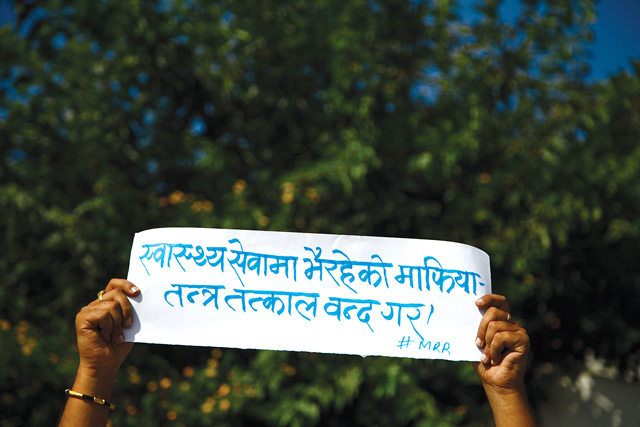
It is because he has seen this ugly underside of medical education that Govinda KC has been on a fast-unto-death so often. His last 13-day hunger strike ended on Sunday after the government assured him that it would clean up the health care sector, but most experts say he may have to fast again because the promises ring hollow.
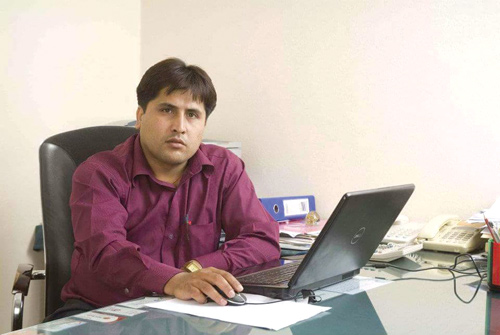
Every time the Institute of Medicine (IoM) and universities publish entrance exam notices, colleges go to the courts to get a stay order to allow admission of Indian students. Mysteriously, the courts always rule in favour of the medical colleges. We posed as students and secretly recorded an interview with Dhruba Poudel of Universal Medical College, who boasted that he had connections with top judges and can win any case.
“No matter how weak students are, it is my responsibility to ensure they clear the tests, we just need the money. Everything will be taken care of,” he told us, even hinting that he had bribed a certain bearded Chief Justice in the past (see box).
The vicious web of corruption begins after the investor with political protection applies for affiliation with some university. The Nepal Medical Council (NMC) inspects the new college to see if it has adequate infrastructure. Most medical colleges established in the past decade do not meet the minimum criteria. But the investors often ‘influence’ the Ministry of Education and the Ministry of Health and Population and various universities to get their permission.
In 2010 an expert committee found that the College of Medical Sciences in Bharatpur and Nobel Medical College in Biratnagar lacked adequate infrastructure and faculties. The NMC had provided a false report based on which the colleges were handed affiliation letters. Five years later, nothing has changed.
Determining the number of student seats for medical colleges is another task for which money changes hands. The NMC is supposed to monitor medical colleges to determine how many students they can take depending on the facilities. Colleges were found to have bribed the NMC and showed fake infrastructure and faculties. As a result, understaffed and ill-equipped medical colleges have mushroomed across the country, producing underqualified doctors and putting millions of lives at risk.
Baburam Marasini, a senior epidemiologist and former registrar at the NMC says: “The government has set clear guidelines but they have not been followed.”
Our investigation also found that surprise inspections are often leaked to colleges, which then fill hospital beds with fake patients and temporary faculty hired overnight to meet the requirements.
Niranjan Kumar Yadav, a recruiter, admitted bringing 52 such faculty members from India for a Nobel Medical College inspection last month. Private medical colleges make up to Rs 10 billion every year. With that kind of money, colleges lobby hard among decision makers offering huge financial incentives to maximise the number of seats while relaxing the criteria to run the MBBS program. It was the result of this intense lobbying, in 2013 NMC reduced the required number of beds in hospital for every student from 7 to 5.5.