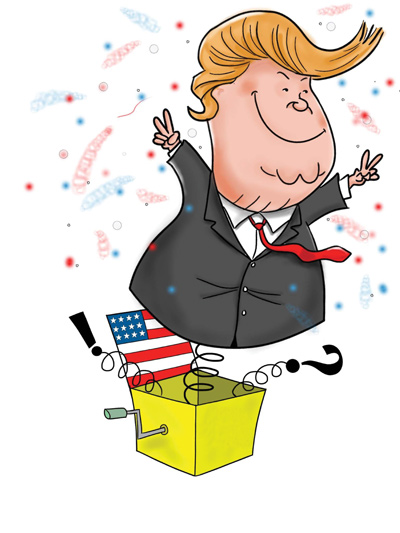
Donald J Trump’s victory in the US presidential election this week shocked Americans and sent shock waves across the world. Here in Nepal, it had analysts scratching their heads about what it means to Nepal, especially the country’s tight balancing act between India and China.
Will President Trump really follow through on his threats to deport illegal migrants, and how will it affect the US administration policy on those seeking political asylum, like the Bhutan refugees?
Trump’s disdain for human rights, his seeming sympathy for Russian President Vladimir Putin and criticism of Barak Obama’s Asian Pivot doctrine vis-à-vis China could dramatically change America’s place in the region. Despite his closeness to Obama, Indian Prime Minister Narendra Modi was one of the first to greet Trump with a warm-hearted message. Some Hindu Indian-Americans were vocal supporters of the Trump campaign.
Analysts say an unpredictable change in the US foreign policy could affect the political economy of East Asia and the Gulf where 2.5 million Nepalis work and send remittance home. What makes some nervous is quickly spreading Syria-Iraq conflict, dragging Saudi Arabia and Iran into the fray, and destabilising the region.
“The direct implication of Trump’s victory will be his policy towards migrants and refugees,” says Nischalnath Pandey of the Centre for South Asian Studies. “But what his approach will be towards India and China will also have consequences for Nepal.”
Aside from strategic implications and foreign policy, there is also worry about what impact an inward-looking America will have on the US official development assistance and funding of the United Nations and non-governmental groups. The US has been one of Nepal’s major development partners for over 60 years with investment in health, education, food security and post-earthquake reconstruction.