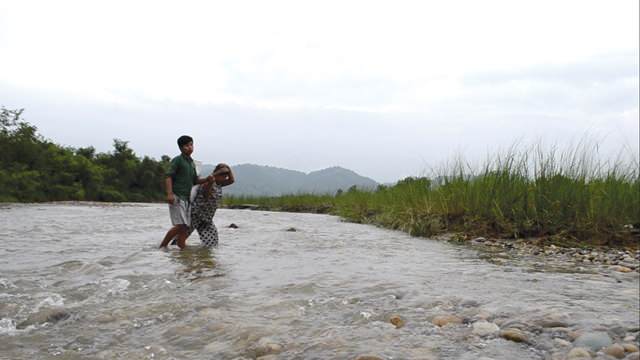
After a rainstorm during last year’s monsoon, Dhaka Mohan Timalsina saw a flash flood rumbling down the Riyu Khola, the river that usually meanders through Madi, the valley that is sandwiched between the jungles of the Chitwan National Park and the Indian border.
A grocery shop owner in Ayodhyapuri village on the southern-most rim of the valley, Timalsina immediately alerted another villager downstream, who relayed the message further along.
The message ran faster than the flood and finally reached Sita Timalsina, who runs a restaurant in Gardi village on the northern-most edge of the valley. She quickly informed local government authorities, police and other villagers.
The flood took nearly two hours to charge through the valley before finally reaching the Narayani River. By then, people living along the Riyu Khola had already fled to safety, freeing cattle and securing important documents like citizenship cards and land ownership certificates. “It was scary, but everybody got the message in the nick of time,” Sita remembers.
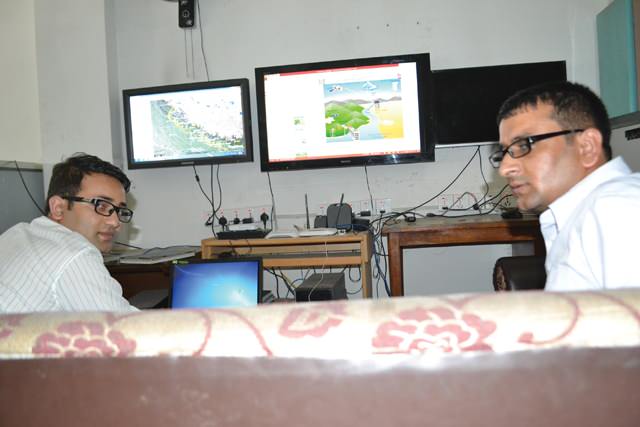
People in Madi have been helping each other to survive flash floods since the Department of Hydrology and Meteorology (DHM) installed a community-based early warning system two years ago under a scheme supported by the Korea International Cooperation Agency (KOICA) and the United Nations Development Programme (UNDP).
Dhaka Mohan and Sita are from two of the four community-based disaster risk management committees in Madi. A resident of the upstream village of Ayodhyapuri, Dhaka Mohan is able to see flash floods before anyone else.
He says: “We rely on each other to survive in this wild valley surrounded by jungles.”
Unlike in most of Nepal, rivers in Madi Valley flow south to north, from the Siwalik to the Narayani. Flash floods are common here, as the rivers meander across the floodplains that are filling up with human settlements. Last year, two people were swept away by the swollen Riyu.