
 Jayanta Acharya, 31, is a young guru of astronomy in Kathmandu's Balmiki College. He's also committed to taking the science to ordinary citizens.
The college is Nepal's only centre for the ancient sciences. Two shastras (ancient knowledge) are taught there: Falit Jyotish (pure astrology) and Siddhanta Jyotish (astronomy). Jayanta teaches astronomy, touching on the achievements of modern and ancient astronomers like Copernicus, Galileo, Ptolemy, Bhaskaracharya, Bramhagupta, and Aaryabhatta.
Jayanta remembers being thrilled as a child, looking at the night sky with his father, Professor Shamba Raj Acharya, head of the Jyotish Faculty at Balmiki.
The young guru wants to do the same for others, and organises public observations of celestial events at the college. If you want to see a Solar Eclipse or the Transit of Venus, Balmiki College is the only place that allows you access to a modern telescope.
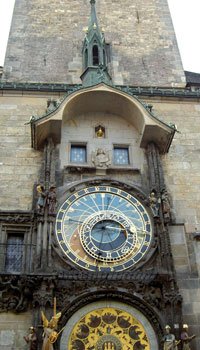
In August this year, Jayanta was the only Nepali participant at the 26th International Astronomical Union (IAU) meeting in Prague, where Pluto was deemed not to be a planet. Jayanta paid his own way, but got to check out the Prague astronomy clock tower (pictured), and meet fellow astronomers.
As a result of Jayanta's visit, though, we know that there are astronomers in China, Japan, and NASA who'd jump at the chance to establish observatories in Nepal, if the government hoops here made the effort worth it.
But we don't have to wait for foreign-funded facilities to enjoy our night skies. Jayanta plans to build a sundial at the college to teach students how ancient scientists kept time. He'll also be organising a series of public observation programs next year for the 50th anniversary of the International Heliophysical Year (IHY), an international organisation that takes astronomy to the general public.