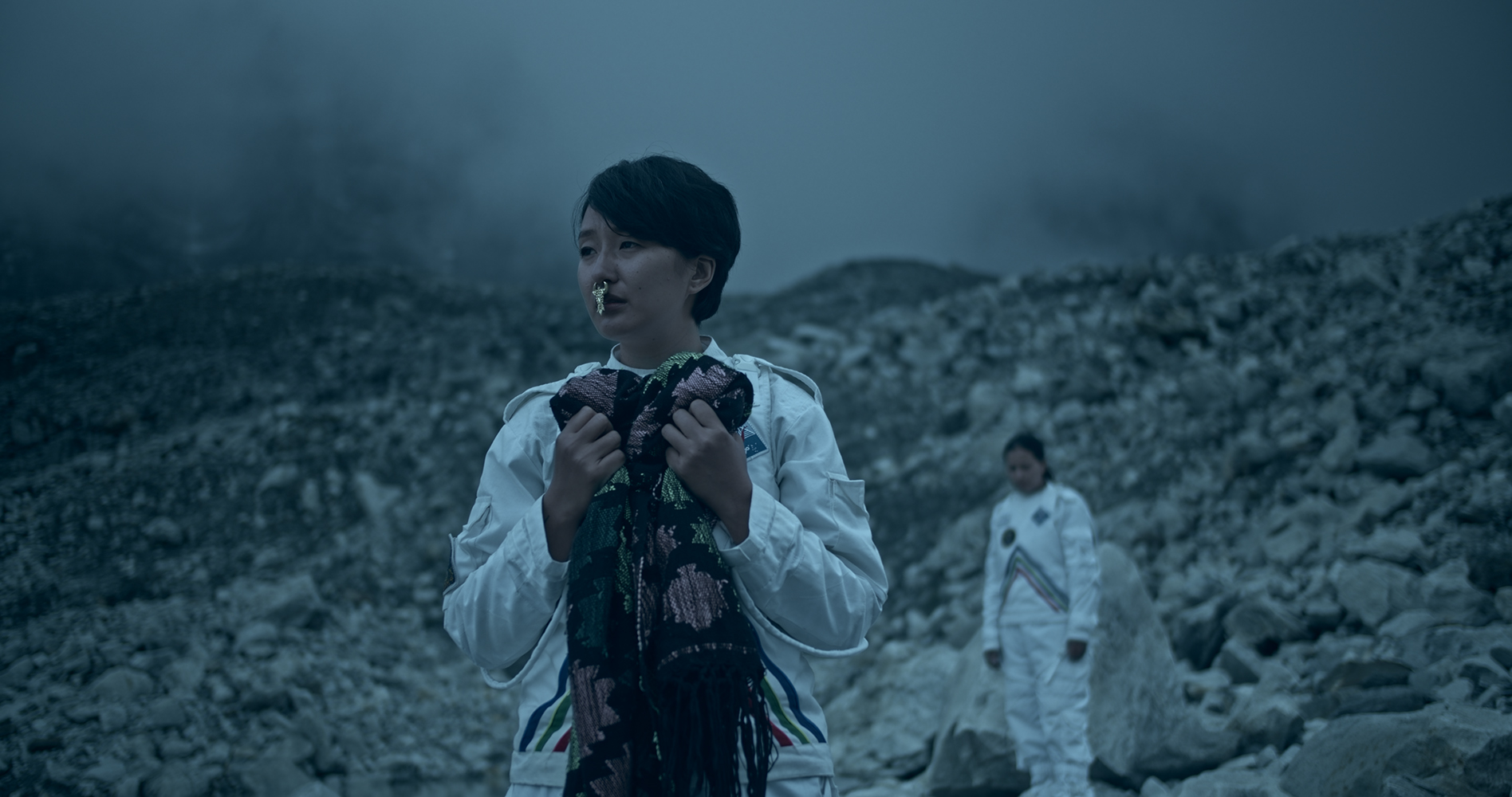
In this bold and beautiful film by Indigenous Yakthung (Limbu) artist Subash Thebe Limbu, two time travellers invite the audience to navigate complex notions of space, memory and the very question of time itself. Through their reflections and mental dialogue with one another, the meditative Miksam and Mingsoma—played by Subin Limbu and Shanta Nepali respectively—explore how our present reality and our sense of what lies ahead might be reimagined by engaging with the unrealised aspirations of historically marginalised communities.
The creator of this extraordinary cinematic offering is a multi-modal artist based in London and Kathmandu whose experiments with sound, film, music, performance, painting and podcasts have resulted in creative works that address deep socio-political issues, practices of resistance and science fiction as well as speculative fiction. Indigeneity and climate change are guiding themes that infuse much of Subash Thebe Limbu’s work.

As a film, Ningwasum is a singular piece of art. Within the Nepali context, it is entirely unique. As much in dialogue with Afrofuturism and Indigenous Futurism as it is with Yakthung cultural and linguistic traditions, Ningwasum summons the viewer to imagine a very different future, a world in which Indigenous peoples have agency, sovereignty, and technology. Perhaps most importantly, it envisions a world where the traditional knowledge systems, ecological understandings, ethical frameworks and storytelling practices of Indigenous communities are not only intact but actually thriving. In so doing, Ningwasum asserts an entirely new way of thinking about what lies beyond the present to offer a transformative and liberatory idea: Indigenous flourishing and genuine self-determination.

Director Limbu has coined a compelling new term for this—‘Adivasi Futurism’. In a related paper of the same title, he argues that this might be imagined as a space for “futures without—or de-link and dismantle—Brahminical patriarchal casteism and racism that has been detrimental to Adivasis, Dalits, Madhesis, women and queer people in the region.” In conceiving of this to be a domain where it becomes possible to “review and redefine progress”, de-linked from nation-states and overturning hackneyed colonial narratives of Indigenous people, Adivasi Futurism becomes a technique for reimagining Indigenous peoples “as not only the storytellers of the past but also as creators of interplanetary and interstellar civilizations of the future.” Ningwasum is an influential intervention in this space, both advancing the cause and stimulating an important conversation around how adivasi janajati cultures and communities are understood by mainstream Nepali society.

As for the film itself, not a great deal happens in Ningwasum, but then it doesn’t need to, as this is no standard issue Kollywood production. This 44-minute arthouse picture, gorgeously shot and suffused throughout with an ethereal blue filter, invites deep contemplation on what it means to have an expansive imagination. The mothership featured in the film is based on a Silam Sakma, a ritual object commonly used and unanimously accepted to be symbol of identity among the Yakthung community. Shot on location in the traditional homeland of the Sharwa (Sherpa) community in eastern Nepal, including in the Wasanglung region which is believed to be the shamanic home of the Yakthung, Ningwasum makes powerful if restrained use of visual effects, and incorporates some dreamy drone footage. With an arresting soundtrack, Ningwasum is entirely in Yakthungpan, known more commonly as the Limbu language.