
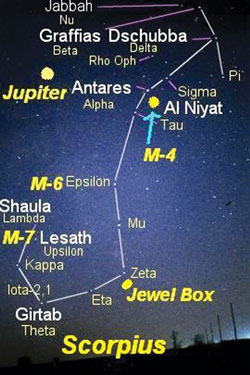
 This month, Saturn, Venus, and Mercury are performing some fancy celestial dances close to the Sun, and will not be visible to us. However, mighty Jupiter will dominate the night sky. During evening hours, look for a bright Jupiter high overhead in the constellation of Ophiuchus. Predawn sky watchers should look out for the red planet Mars in the constellation of Taurus the Bull.
Weather permitting, get ready to enjoy celestial fireworks this month. August brings the well-known Perseid meteor-shower, the best of the year. Perseids can be seen from late July to late August, but the peak is expected in the early hours of 13 August. Tiny particles of dust and rock left by the Swift-Tuttle comet will smash into Earth's atmosphere at a speed of 215,000km per hour, producing a brilliant display of shooting stars.
Perseids are a rich and consistent meteor shower and you can expect to see one Perseid a minute. They all seem to radiate from a point in the constellation of Perseus, which is high in the east by dawn. Since the Moon is New, the sky will be very dark, making this an incredible display.
Also during August enjoy the red-giant variable star Antares, a brilliant jewel at the heart of one of the great constellations, the Zodiac's Scorpius. (The brightness of variable stars changes periodically). Antares is easy to find a little south of Jupiter. Antares means 'Mars's rival' and many a stargazer has mistaken this ruddy red star for the planet Mars. With a size of 15 to 18 solar masses, Antares probably does not have much time left, since super massive stars quickly exhaust their hydrogen fuel and explode as brilliant supernovas.