
 |
July was quite something, wasn't it, with the 40th anniversary of the first moon landing and the most spectacular total solar eclipse of the century.
The highlights of August are the summer meteor shower and the grand-standing of Jupiter opposite to the sun throughout the night sky.
In the evening hours, you will see the 'Square of Pegasus' in the eastern horizon and the 'Great Summer Triangle' high in the east along the Milkyway band. The western sky will be kind of dull, but dominated by the Big Dipper (Saptarshi).
August brings the well-known Perseid meteor-shower: intense streaks of light across the night sky caused by small bits of interplanetary rock and debris called meteoroids as they crash and burn high in Earth's upper atmosphere. When a meteor appears, it seems to 'shoot' quickly across the sky with intense brightness that might make you think it is a falling star. Travelling at thousands of km an hour, meteoroids quickly ignite in searing friction of the atmosphere, 100 km above the ground. Almost all are destroyed in this process, the rare few that survive and hit the ground are known as meteorites.
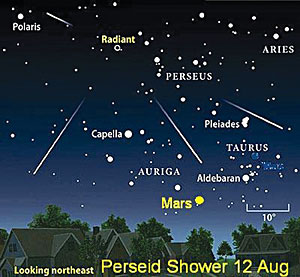
Perseids seem to radiate from a point in the constellation of Perseus, which rises around mid-night and is high in the east by dawn. These meteors may be seen any time from late July to late August, but the peak this year is expected on the night of 12 August. However, there should be good numbers of meteors on the previous night (11 August), increasing in theory to one shooting star every two or three minutes towards dawn. Unfortunately, the gibbous Moon will be only 35 degrees to the right of the radiant point, and its light will tend to drown out all but the brightest meteors. To minimise the effect, try looking to the left of the radiant, at 90 degrees to the Moon.