
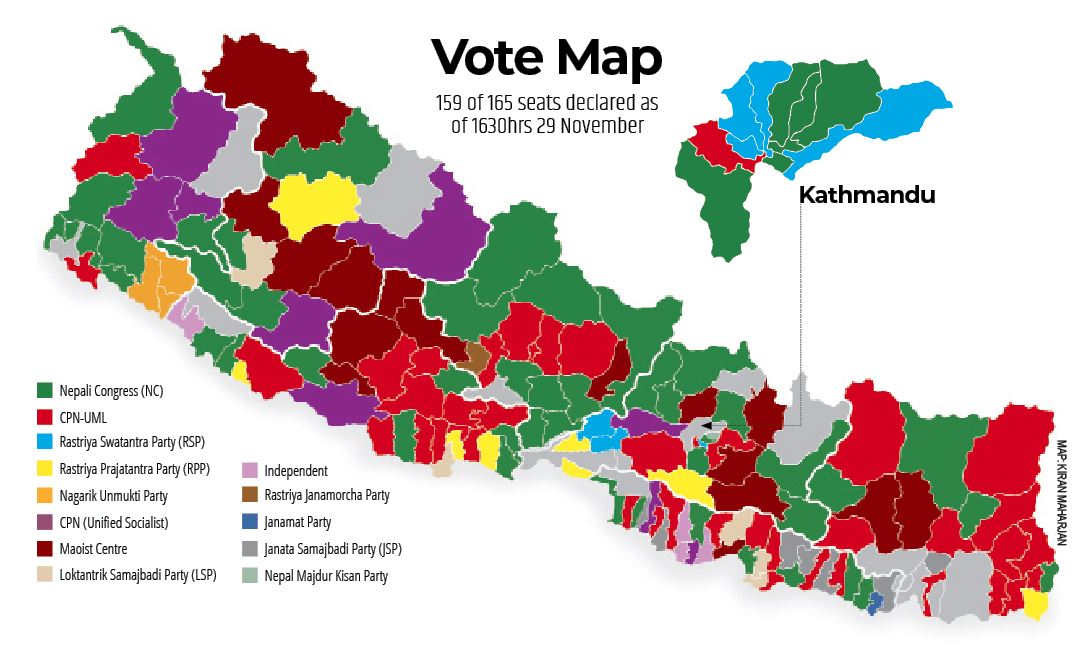
The last time there was a Parliament in Nepal as hung as this one after an election, it was back in 1994.
As the last ballots of the 20 November elections are counted none of the parties have reached the magic 138 necessary to form a government in the 275-member House of Representatives (165 directly elected, and 110 chosen by the political parties in proportion to the votes they get).
The Nepali Congress (NC) and the UML are first and second in the direct count. And in the proportional representation ballot, the UML is first and NC second.
The NC or the UML will need the Maoist Centre, the independent RSP, or the royal-right RPP to form the next government.
The two big parties can add other smaller parties, but the more members of a coalition there are, the more complicated it will be to satisfy everyone to form a government.
And we have seen from the past that could be the source of an unstable government. In midterm elections in 1994, the the UML got 88 seats and the NC 83 — leading to a period of fluid politics in which the UML allied with Lokendra Bahadur Chand and the NC with Surya Bahadur Thapa, making the two Panchayat-era figures prime ministers.
Not only did this begin an era of dirty politics, but also squandered the gains of the 1990 People’s Movement. There is a lesson from that for 2022: don’t take the support of fringe parties just to be prime minister.
It is also an insult to the popular mandate. After all, why try to be the first or second party if that does not count? Just adding up seats for a technical majority without a specific ideology or program is to let the people down. Such a coalition will not fulfil voters’ desire for development and prosperity.