
Pastor Narkaji Gurung of Pokhara's Zion Grace Church and second-generation believer Sradda Thapa of the Areopagus Congregation talk of their beliefs and on being a Christian in a Hindu-majority society.
The general understanding of Christianity in Nepal is that it was a very small community prior to 1990, when proselytising was still illegal, but that it is now growing apace. Will the 2010 census to be revealing? 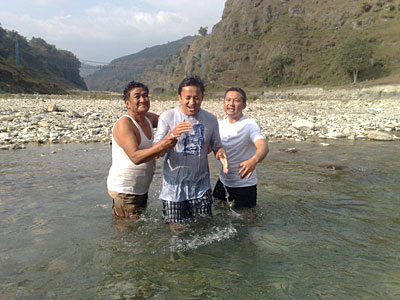
Narkaji Gurung: Before1990, according to official government reports, the numbers of Christians were small. However, there may have been more who were closet Christians due to the fear of opposition from family, community, and the government, and other who were unaccounted for. Post 1990, many of these closet Christians have come out. Moreover, now that we are able to freely evangelise, more people have the opportunity to hear and receive Christ as their saviour. So yes, the 2010 census will be revealing in this regard.
Sradda Thapa: One of the basics of democracy is freedom of choice, including that of religion, so it would seem natural that with the end of the criminalisation of Christianity, more Nepalis would be open to exploring their faith or admitting to it. As for the census, any minority group would naturally hope for an accurate reflection of reality!
Why do you think so many Nepalis are willing to convert now, and which communities are they concentrated in?
NG: Conversion is a matter of personal free will. People may convert for various reasons, some of which may be self-motivated but in the course of time those who are genuine converts will be revealed.
I don't think conversion is concentrated in any particular community though generally the poor have been more receptive to the message of Christ's deliverance. This not surprising considering they are the most oppressed. Our small church of around 80 represents nearly all strata of Nepali society.
ST: I'm not sure if more Nepalis are willing to convert now or if the removal of a state religion (which labelled others as un-Nepali and hence 'illegal') has permitted Nepalis to be more open. But we've come a long way since the bugging of Christian leaders' phones and open threats.
What is it like to be a Christian in Hindu-majority Nepal? Is there suspicion towards the community, and what would you say to Hindus who may feel that in a secular state they are 'losing their religion'?
NG: It is a great privilege and also at the same time challenging in a positive way. Personally, I think the Nepali community as a whole is very welcoming and friendly to Christians. One thing that must be made clear is that Christ did not come to start a new religion so the Nepali people should not feel threatened that they will lose their religion. However, truths in the Bible do challenge us to revaluate our religious concepts and practices, whether be it Hinduism, Buddhism, Islam or even Christianity itself.
ST: Since my childhood, when I was scared to proclaim my faith, to my teenage years, when non-Christian Nepalis perceived me as less of a Nepali at best and more of a traitor at worst, things have gotten better. These days, well-travelled, educated and urban Nepalis are more open to the idea of freedoms, so there are opportunities to learn about each other's faiths. Actually I feel Christianity can help expand Nepali culture; we sing Christian hymns to Nepali tunes, wear traditional clothes and serve Nepali meals at our functions.
Institutionally – from the state that still frowns upon proselytising to media houses that run Dasain specials but not Lhosar, Eid or Christmas specials to schools that do not post 'Merry Christmas' on bulletin boards like they would for 'Vijaya Dashami', minority groups obviously realise that they still reside in a 'Hindu' state. But I don't think I feel threatened or consider it malicious – it's been an opportunity for me to experience how it must be like for Hindu Nepalis in culturally Christian countries elsewhere. It's made me consider how to make spaces more comfortable for the marginalised and minorities of any kind.